
Public companies have limited time to comply with Form 8-K filing requirements after certain material events occur. For most reportable events, the U.S. Securities and Exchange Commission (SEC) requires a Form 8-K to be filed within four business days. Missing that deadline can lead to SEC scrutiny, affect disclosure controls and procedures, and increase compliance risk for public companies.
The challenge is often not preparing the filing itself. It is determining what triggers a Form 8-K. While many reportable events are specifically identified under SEC Item requirements, others require materiality assessments and legal judgment within a compressed reporting timeline.
This guide is a practical resource for legal teams, investor relations (IR) professionals, and finance leaders responsible for SEC reporting. It explains the Form 8-K filing requirements, outlines common 8-K material events, and provides a practical Form 8-K disclosure checklist to help determine when to file Form 8-K and support a consistent disclosure workflow.
What Is a Form 8-K?
Form 8-K is the SEC's current report that public companies use to disclose specified material events that occur between periodic filings, including Form 10-K and Form 10-Q. Unlike those scheduled reports, Form 8-K provides investors with timely information about significant corporate developments that may affect investment decisions.
Under the form 8-K filing requirements, most reportable events must be disclosed within four business days after the triggering event, unless the applicable Item under Form 8-K specifies a different deadline. Because the filing period begins when the event occurs, companies need effective disclosure controls to identify reportable events, assess materiality, and begin the filing process promptly.
Rather than restating the SEC's complete instructions, this guide focuses on the practical question legal, investor relations, and finance teams face every reporting cycle: what triggers a Form 8-K and when to file Form 8-K. For the complete filing instructions and Item requirements, refer to the SEC's official Form 8-K guidance.
The next section breaks down the Form 8-K Item categories that trigger disclosure and provides a practical framework for evaluating 8-K material events.
The 18 Form 8-K Items That May Trigger Disclosure
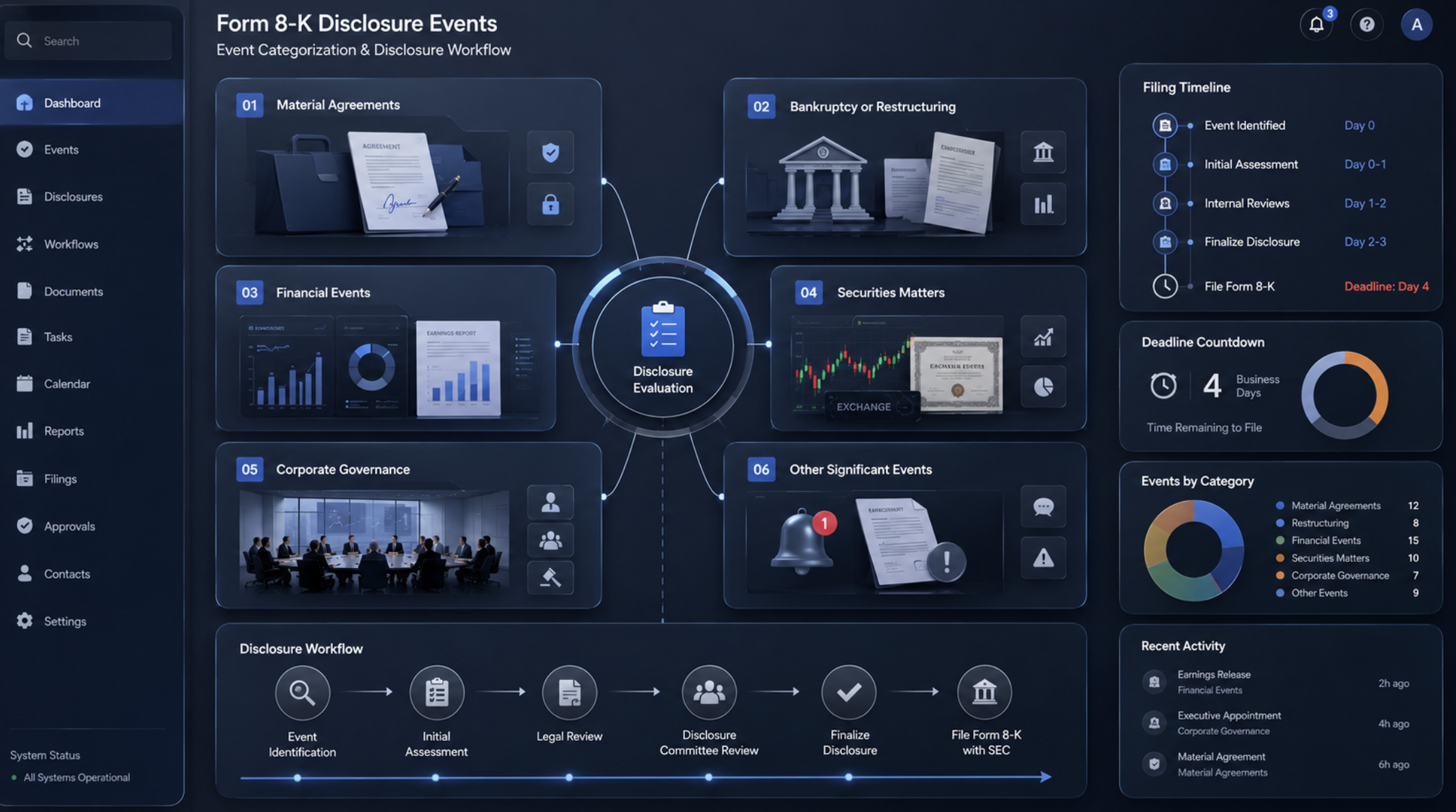
The form 8-K filing requirements organize reportable events into 18 Items (Items 1.01 through 9.01) across nine reporting sections. Each Item identifies a category of corporate events that may require current disclosure. When evaluating what triggers a Form 8-K, legal and investor relations teams typically begin by identifying the applicable Item before assessing materiality, drafting the disclosure, and confirming the filing deadline.
The table below summarizes the most common 8-K material events and the corresponding reporting categories.
| Reporting Section | Common Event | Applicable Item(s) | Typical Disclosure Focus | Filing Timeline* |
|---|---|---|---|---|
| Section 1: Registrant's Business and Operations | Material definitive agreements, termination of agreements, bankruptcy, receivership | Items 1.01-1.05 | Nature of the event, contractual obligations, operational impact | Generally 4 business days |
| Section 2: Financial Information | Acquisitions, dispositions, earnings releases, impairments, restructurings | Items 2.01-2.06 | Financial impact, accounting effects, supporting disclosures | Item-specific |
| Section 3: Securities and Trading Markets | Delisting notices, unregistered equity sales, shareholder rights changes | Items 3.01-3.03 | Securities impact and investor implications | Generally 4 business days |
| Section 4: Matters Related to Accountants | Auditor changes, reportable disagreements, non-reliance on financial statements | Items 4.01-4.02 | Auditor relationship and financial reporting implications | Generally 4 business days |
| Section 5: Corporate Governance and Management | Director and executive officer changes, governance amendments, shareholder voting results | Items 5.01-5.08 | Leadership, governance, executive compensation, corporate actions | Generally 4 business days |
| Section 6: Asset-Backed Securities | Asset-backed securities reporting events | Items 6.01-6.05 | Asset-backed securities disclosures | Item-specific |
| Section 7: Regulation FD | Public disclosure of material nonpublic information | Item 7.01 | Information furnished under Regulation FD | As applicable |
| Section 8: Other Events | Material developments not addressed elsewhere | Item 8.01 | Other information management considers important to investors | Generally 4 business days |
| Section 9: Financial Statements and Exhibits | Required financial statements and exhibits supporting another reportable event | Item 9.01 | Financial statements, pro forma financial information, exhibits | Item-specific |
Most Form 8-K Items require filing within four business days, although certain Items have different deadlines under SEC rules.
How Legal Teams Use the 18 Reporting Sections
Rather than memorizing all 18 Items, legal and compliance teams often review potential disclosure obligations by reporting section:
- Section 1 covers significant business events, including material definitive agreements and bankruptcy proceedings.
- Section 2 focuses on financial events such as acquisitions, dispositions, restructurings, impairments, and certain earnings announcements.
- Section 3 addresses securities offerings, exchange listing matters, and shareholder rights.
- Section 4 applies to auditor changes and circumstances involving previously issued financial statements.
- Section 5 includes director and executive officer changes, governance updates, executive compensation, and shareholder voting results.
- Section 6 contains reporting requirements specific to asset-backed securities issuers.
- Section 7 covers information furnished under Regulation FD.
- Section 8 provides a reporting category for other material events not addressed by another Item.
- Section 9 identifies when financial statements, pro forma financial information, or exhibits must accompany a filing.
Identifying the applicable Item is only the first step. Whether an event requires disclosure also depends on the underlying facts, the applicable SEC rule, and the company's materiality assessment. Those judgment calls are often the most challenging part of determining when to file Form 8-K, which the next section explores.
What Triggers a Form 8-K When Materiality Is Unclear?
The 18 Form 8-K Items That May Trigger Disclosure

Not every event that affects a public company automatically triggers a Form 8-K. While some form 8-K filing requirements are tied to specific reporting Items, others require legal and factual analysis before determining whether current disclosure is required.
In these situations, legal, investor relations, finance, and executive leadership should identify the applicable Form 8-K Item, evaluate materiality, and document the basis for the decision. A consistent review process helps support disclosure controls and creates a clear record of the company's reporting analysis.
Executive Departures
Changes in senior leadership do not automatically require a Form 8-K. Reporting obligations depend on the executive's role and the circumstances surrounding the event. Under Item 5.02, companies generally evaluate whether the resignation, retirement, appointment, or termination of a director, principal executive officer, principal financial officer, principal accounting officer, or other covered executive triggers disclosure. Related employment agreements or compensation arrangements may also require reporting.
Before filing, disclosure teams should confirm:
- Whether the individual is covered by Item 5.02.
- Whether the event creates a reporting obligation under the applicable Item.
- Whether related compensation or employment arrangements require disclosure.
Cybersecurity Incidents
Cybersecurity incidents often require ongoing materiality assessments because the scope and business impact may change as an investigation develops. Under the SEC's cybersecurity disclosure rules, registrants generally must disclose a material cybersecurity incident under Item 1.05 within four business days after determining the incident is material. The filing deadline begins after the materiality determination, not when suspicious activity is first detected.
Disclosure teams should evaluate:
- The scope and severity of the incident.
- The actual or reasonably likely impact on operations, financial condition, or investors.
- Whether new facts change the materiality assessment before filing.
Litigation Settlements and Regulatory Matters
Litigation, regulatory investigations, and settlement negotiations do not automatically require current reporting. Legal teams should determine whether the development falls within a specific Form 8-K Item or represents a material event requiring disclosure. For example, a settlement that materially affects the company's financial condition or operations may require reporting, while routine litigation or preliminary negotiations generally do not. Documenting the applicable reporting Item, materiality assessment, and supporting analysis helps maintain consistent disclosure controls.
Form 8-K Disclosure Checklist for Legal and IR Teams
Once a potential 8-K material event has been identified, legal and investor relations teams should follow a structured process to determine when to file Form 8-K, prepare the required disclosure, and meet the SEC's four-business-day deadline.
Step 1: Identify the Triggering Event
Document the key facts before beginning the disclosure review. Confirm:
- What happened?
- When did it occur?
- Who was involved?
- Which Form 8-K Item may apply?
Establishing the facts early helps reduce delays later in the filing process.
Step 2: Assess Materiality
Determine whether the event requires disclosure under the applicable Form 8-K filing requirements. Consider:
- Would a reasonable investor consider the information important?
- Does the event materially affect the company's operations, financial condition, governance, or securities?
- Is additional legal analysis required?
Materiality assessments often involve legal, finance, investor relations, executive management, and the disclosure committee.
Step 3: Identify the Applicable Reporting Item
Match the event to the appropriate Form 8-K Item. Verify:
- Applicable reporting Item
- Filing deadline
- Required exhibits
- Related disclosure obligations
Selecting the correct Item early helps streamline drafting and internal review.
Step 4: Prepare the Disclosure
Draft a clear, factual disclosure that satisfies the applicable SEC reporting requirements. Include:
- A concise description of the event
- Relevant dates
- Material facts or contractual terms
- Required supporting exhibits
Reviewing comparable EDGAR filings also helps maintain consistency with prior SEC disclosures. For guidance on locating relevant precedent filings, see How to Use EDGAR for SEC Filings.
Step 5: Complete Internal Review
Before filing, obtain review from the appropriate stakeholders, including:
- Legal counsel
- Finance and accounting
- Investor relations
- Executive management
- Disclosure committee, when applicable
Confirm factual accuracy, consistency with prior SEC filings, and completeness before final approval.
Step 6: File Within Four Business Days
Submit the filing through EDGAR after confirming:
- The correct Form 8-K Item has been selected.
- Required exhibits are attached.
- Dates and factual statements have been verified.
- Internal approvals are complete.
Maintaining a repeatable Form 8-K disclosure checklist helps legal and IR teams apply consistent disclosure controls, reduce review time, and meet SEC filing deadlines with greater confidence.
Common Form 8-K Filing Mistakes
Even experienced legal and investor relations teams can make filing errors when working under the SEC's four-business-day deadline. In most cases, the issue is not a lack of knowledge of the Form 8-K filing requirements, but inconsistent disclosure workflows, incomplete documentation, or delayed decision-making.
Common mistakes include:
- Delaying the materiality assessment. Waiting too long to determine whether an event is material reduces the time available for legal review, executive approvals, drafting, and EDGAR submission. Materiality should be evaluated as soon as a potential 8-K material event is identified.
- Selecting the wrong Form 8-K Item. Some corporate events may appear to fit multiple reporting Items. Filing under an incorrect Item can result in revisions, amended disclosures, or additional legal review before submission.
- Overlooking required exhibits or supporting documentation. Certain Form 8-K Items require exhibits or additional supporting information. Confirming documentation requirements before filing helps reduce avoidable deficiencies. For related guidance, see Financial Statement Disclosure Checklist.
- Using disclosure language that is inconsistent with prior SEC filings without a valid reason. Changes in wording should reflect changes in facts or circumstances. Comparing relevant precedent filings helps maintain consistency and supports defensible disclosure decisions.
- Unclear internal review responsibilities. Legal, finance, investor relations, executive management, and the disclosure committee should follow a documented review process. Clearly assigned responsibilities help reduce omissions and support effective disclosure controls.
The SEC evaluates not only whether a Form 8-K is filed on time, but also whether the company's disclosure controls and procedures support accurate, complete, and timely reporting. A standardized Form 8-K disclosure checklist, documented materiality assessments, and consistent review procedures help legal and IR teams reduce compliance risk while meeting SEC reporting deadlines.
How AI Drafting Tools Reduce Form 8-K Turnaround Time
Meeting the form 8-K filing requirements often means evaluating materiality, identifying the correct reporting Item, reviewing prior EDGAR filings, drafting disclosures, and completing internal approvals within four business days. Much of that time is spent on research rather than drafting.
Precedent-based AI helps accelerate this process by supporting repetitive, research-intensive tasks. It can help legal and investor relations teams:
- Find comparable EDGAR filings for similar corporate events or transactions.
- Surface relevant precedent language with traceable source references.
- Generate structured draft disclosures based on verified SEC filings.
- Compare current disclosures with prior company filings to improve consistency.
- Support review with auditable outputs linked to the underlying source material.
Dimension AI is designed specifically for SEC filing workflows. Rather than generating generic text, it uses precedent-based AI to help teams research comparable EDGAR filings, prepare draft disclosures, and verify every output against traceable source documents. This approach helps reduce manual research while maintaining enterprise security, auditability, and attorney oversight.
AI improves efficiency, but legal judgment remains essential. Legal counsel, investor relations, finance teams, and disclosure committees continue to determine materiality, approve disclosure language, and confirm that each Form 8-K satisfies SEC reporting requirements before filing.
Improve Form 8-K Drafting With EDGAR-Based Precedent
Meeting the form 8-K filing requirements requires more than filing within four business days. Legal and investor relations teams must evaluate materiality, identify the correct reporting Item, research comparable EDGAR filings, and prepare disclosures that are accurate, consistent, and fully supportable.
Dimension AI is built for compliance-intensive SEC reporting workflows. Its precedent-based AI helps legal teams research relevant EDGAR filings, draft disclosures using traceable source documents, and produce auditable outputs while preserving attorney oversight throughout the review process. Rather than replacing legal judgment, the platform reduces the manual effort required to locate precedent, compare disclosures, and maintain consistency across filings. This allows legal and compliance teams to focus on materiality assessments, disclosure quality, and timely SEC reporting.
See how the Dimension AI Platform helps legal teams draft accurate Form 8-K disclosures using EDGAR precedent.
To access this endpoint, you must have an approved developer account, and have activated the new developer portal. When authenticating, you must use keys and tokens from a developer App that is located within a Project. Learn more about getting access to the API v2 endpoints in our "Getting started" page:
Once you have the API v2 collection loaded in Postman
The hide replies endpoint uses OAuth 1.0a user context authentication. If successful, the endpoint hides a single Reply that was published in a Tweet conversation that was initiated by an authenticated user. Each conversation supports hiding up to 725
This endpoint gives you the ability to programmatically hide or unhide replies using criteria you define. Just like the functionality in the main
There are several different tools and libraries that you can use to make a request to this endpoint, but we are going to use the Postman tool here to simplify the process.