Introduction
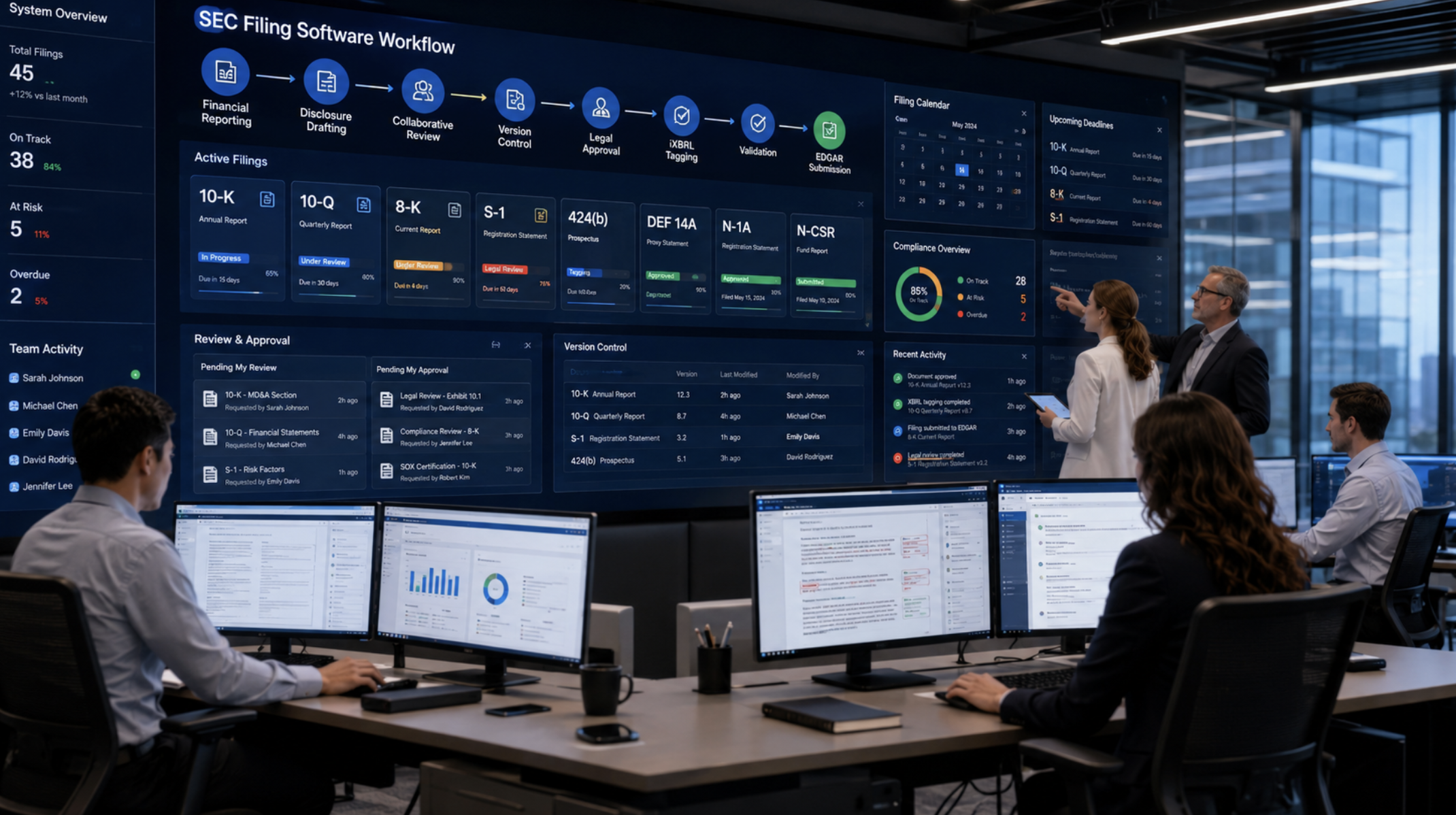
SEC filing software helps public companies and their legal and finance teams prepare, review, and submit required filings to the SEC. It covers workflows for annual reports (10-K), quarterly reports (10-Q), current reports (8-K), registration statements (S-1, 424(b)), and fund filings. Modern SEC filing tools fall into three categories: enterprise reporting suites, EDGAR and iXBRL infrastructure, and AI-assisted drafting and review layers. Most public companies use tools from more than one category across their filing cycle.
Preparing SEC filings involves more than drafting a document. Public companies must coordinate financial reporting, legal disclosures, regulatory deadlines, EDGAR submission, and multi-stakeholder review while maintaining complete documentation throughout the filing process. For professionals who are new to SEC reporting software, understanding how dedicated tools support these workflows is an important first step before evaluating available solutions.
This guide explains what SEC filing software is, how it supports the SEC reporting process, and where it fits within the broader compliance workflow. Rather than comparing vendors or recommending platforms, it provides a practical overview of the software category, the problems it solves, and how different types of SEC filing software support drafting, review, collaboration, and electronic filing.
What Is SEC Filing Software?
SEC filing software is a category of SEC reporting software that helps public companies prepare, review, manage, and submit required filings to the U.S. Securities and Exchange Commission (SEC). These tools support the reporting lifecycle for filings such as Form 10-K, Form 10-Q, Form 8-K, registration statements, and other required disclosures by helping teams manage drafting, document review, collaboration, filing preparation, and submission.
SEC filing software is used by legal teams, finance and accounting departments, investor relations professionals, external auditors, outside counsel, and filing agents. It exists because SEC reporting involves high-stakes legal and regulatory documents that must be completed under strict deadlines, coordinated across multiple stakeholders, and supported by accurate records of every revision. Manual document management alone is often insufficient for these complex workflows.
Unlike general document editing tools, SEC compliance software includes capabilities designed specifically for regulatory reporting. Depending on the platform, these may include version control, approval workflows, EDGAR preparation, Inline XBRL (iXBRL) tagging, validation checks, and audit trail retention. Together, these features help organizations produce accurate, compliant filings while maintaining the governance and traceability expected throughout the SEC reporting process.
What Filing Types Does SEC Software Support?
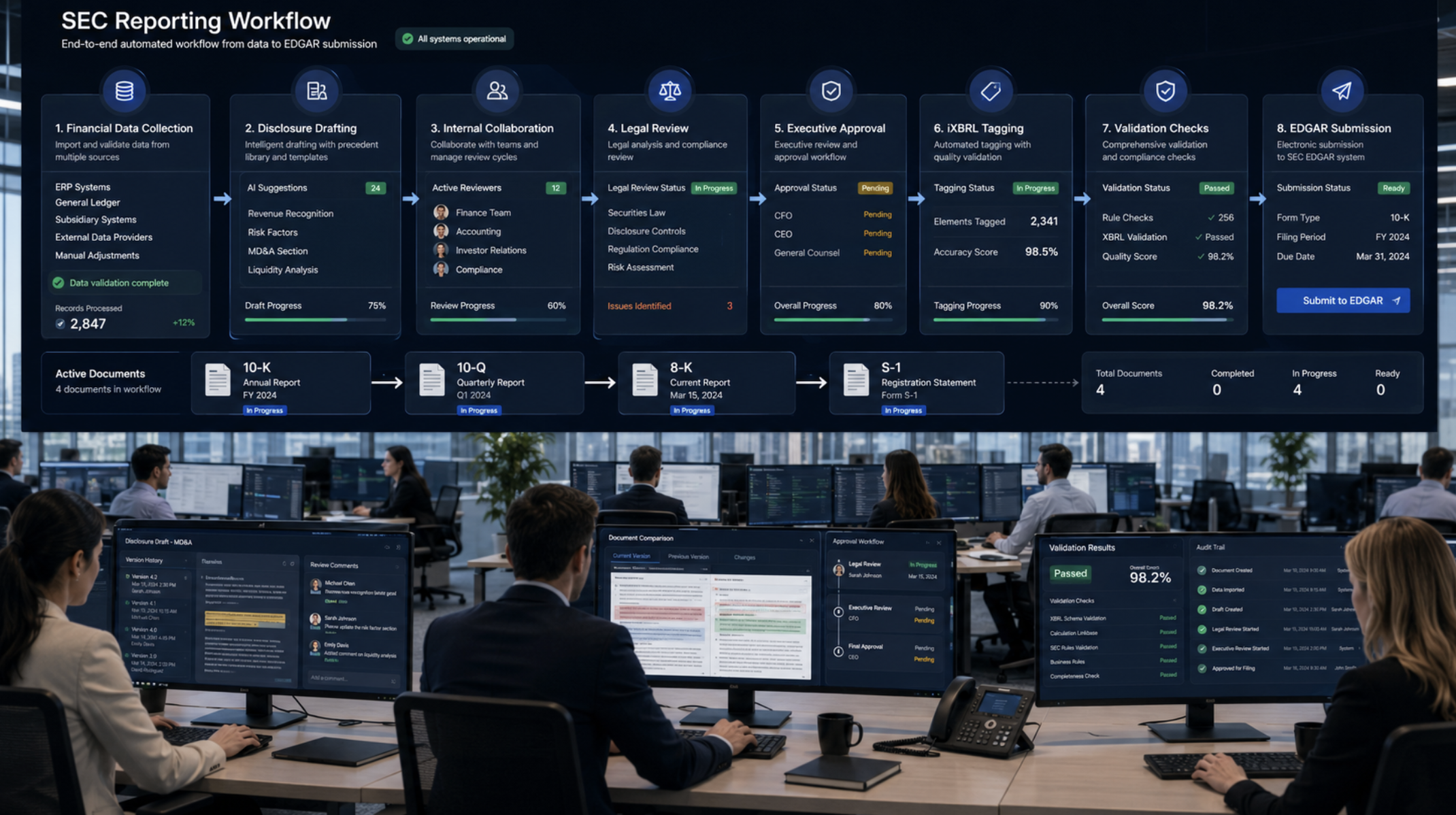
SEC filing software supports the preparation, review, and submission of the disclosure documents that public companies file with the U.S. Securities and Exchange Commission (SEC). While each filing has a different regulatory purpose, they all require coordinated drafting, stakeholder review, technical validation, and electronic submission through EDGAR.
Common filing types include:
- Form 10-K: Annual report that includes audited financial statements, business operations, risk factors, and Management's Discussion and Analysis (MD&A). Learn more about 10-K vs. 10-Q differences.
- Form 10-Q: Quarterly report that provides interim financial statements and updates on a company's financial performance between annual reporting periods.
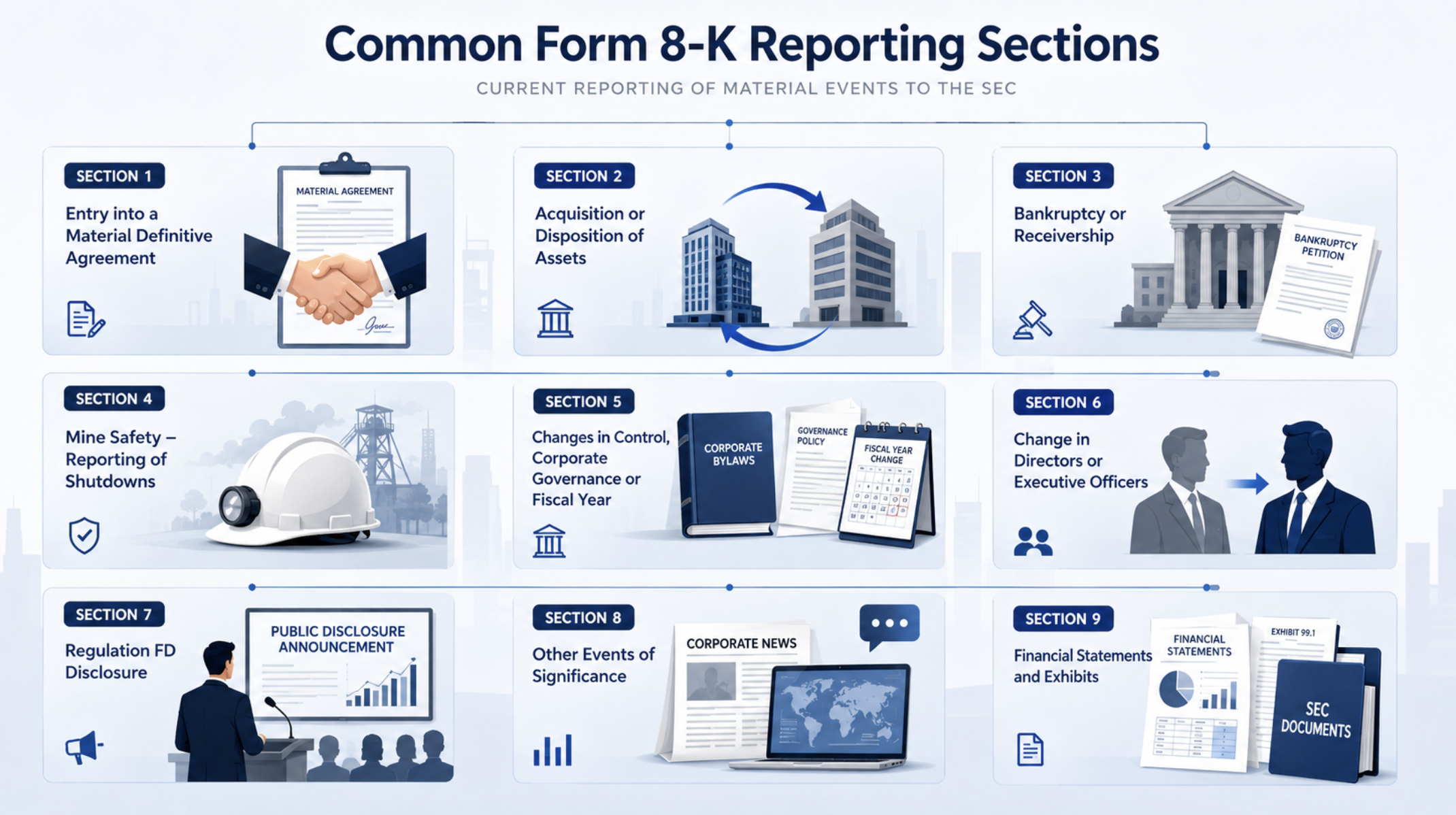
- Form 8-K: Current report used to disclose material events, including executive leadership changes, acquisitions, material agreements, and other reportable events. See our guide to Form 8-K reporting requirements.
- Form S-1: Registration statement used to register securities, most commonly for an initial public offering (IPO).
- Form S-3: Short-form registration statement available to eligible reporting companies that meet SEC filing requirements.
- Form 424(b): Prospectus filing that contains offering-specific information after a registration statement becomes effective.
- DEF 14A: Definitive proxy statement that supports shareholder voting on matters such as director elections, executive compensation, and corporate governance.
- Form N-1A: Registration form for open-end investment companies, including mutual funds.
- Form N-CSR: Certified shareholder report filed by registered investment management companies.
Although each filing has different disclosure requirements, they all rely on structured review, version control, regulatory validation, and timely submission. SEC reporting software helps legal, finance, and compliance teams manage these workflows consistently while supporting accurate, compliant reporting across recurring and transaction-driven filings.
How Does SEC Filing Software Work?
Although every reporting process differs, most SEC filing software follows the same workflow for recurring filings such as Form 10-K. The software supports drafting, collaboration, technical validation, and submission while helping legal, finance, accounting, and investor relations teams maintain governance throughout the reporting process.
Step 1: Search Prior Filings
The workflow begins by searching prior Form 10-K filings and other disclosures available through EDGAR. Teams identify and extract relevant precedent language, compare historical disclosures, and determine which sections require updates based on current financial results, business developments, and regulatory requirements.
Step 2: Prepare the Draft
The current filing is built using prior disclosures, updated financial statements, and new narrative sections such as Management's Discussion and Analysis (MD&A) and risk factors. Some organizations also use AI-assisted tools to organize precedent language and supporting content before drafting begins.
Step 3: Review and Collaborate
Legal, finance, accounting, investor relations, external auditors, and outside counsel review the filing. SEC reporting software centralizes version control, comments, tracked changes, and approval workflows so every stakeholder works from the same document.
Step 4: Apply Inline XBRL (iXBRL)
Financial statements receive Inline XBRL (iXBRL) taxonomy tags required for machine-readable SEC reporting. Tagging is completed within the reporting platform or through an integrated filing provider.
Step 5: Validate and Submit Through EDGAR
Before submission, the filing undergoes pre-flight validation to identify formatting issues, taxonomy errors, missing exhibits, and other technical issues. EDGAR filing software, enterprise reporting platforms, or filing agents then transmit the validated filing through the EDGAR system.
Step 6: Maintain an Audit Trail
After submission, organizations retain filing confirmations, exhibits, review history, and supporting documentation. These records support future reporting cycles, internal governance, regulatory compliance, and audit requirements.
To see how AI-assisted drafting and precedent-based review fit within this workflow, explore the Dimension AI platform.
The Three Categories of SEC Filing Software
Most organizations use more than one type of SEC filing software because different tools support different stages of the reporting lifecycle. Broadly, the market consists of three categories that work together to prepare, review, validate, and submit SEC filings.
| Category | Primary Role | Common Examples |
|---|---|---|
| Enterprise reporting suites | Manage recurring reporting, collaboration, iXBRL tagging, and EDGAR submission | Workiva, DFIN ActiveDisclosure, Toppan Merrill Bridge |
| EDGAR and filing infrastructure | Validate filings and support electronic submission | Filing agents, Arelle, taxonomy validation tools |
| AI-assisted drafting and review | Accelerate drafting and review before submission | Dimension AI and similar AI-assisted tools |
The three categories include:
- Enterprise reporting suites serve as the system of record for recurring SEC reporting. They centralize document collaboration, linked financial data, workflow management, iXBRL tagging, and EDGAR submission.
- EDGAR filing infrastructure focuses on the technical mechanics of filing with the SEC. Filing agents, Arelle, and taxonomy validation tools help validate filings and prepare documents for successful EDGAR submission.
- AI-assisted drafting and review supports the workflow before submission. These tools help legal and finance teams identify precedent language, compare disclosures, and accelerate review while preserving source traceability. Dimension AI is one example of this category. Learn more about AI vs. manual SEC filing workflows.
For a detailed comparison of available platforms, read our guide to best SEC filing software for AI-assisted review.
Why Can't Public Companies Just Use Word and Email?
For simple business documents, Microsoft Word and email may be enough. SEC filings are different. They are legal and regulatory documents that require coordinated review, technical validation, and a complete audit trail under strict filing deadlines. Dedicated SEC filing software exists because general productivity tools cannot manage these requirements efficiently.
- Version control becomes difficult at scale. A single filing may involve legal, finance and accounting, investor relations, external auditors, outside counsel, and filing agents. Managing reviews across shared drives and email chains increases the risk of conflicting versions and missed changes.
- Word cannot support EDGAR submission. SEC filings often require Inline XBRL (iXBRL) tagging and validation before submission. EDGAR filing software or filing agents provide these capabilities.
- Reporting deadlines leave little room for manual coordination. Form 8-K filings are generally due within four business days, while many accelerated filers have 60 days to file an annual Form 10-K. Structured workflows are more efficient than sequential email reviews.
- Auditability matters. SEC reporting requires a traceable history of edits, approvals, and review decisions. Email chains do not provide the governance or audit trail expected for regulated reporting.
- The stakes are higher than document editing. Because SEC filings carry legal and regulatory consequences, SEC reporting software provides the workflow controls, governance, and technical infrastructure needed to support accurate, compliant submissions.
Who Uses SEC Filing Software?
SEC filing software supports every stakeholder involved in preparing, reviewing, and submitting regulatory filings. It provides a shared workflow that improves collaboration, version control, and auditability throughout the reporting process.
- In-house legal teams review disclosures for compliance with SEC regulations and securities laws.
- Finance and accounting teams prepare financial statements, supporting schedules, and periodic disclosures.
- Investor relations teams ensure public communications align with filed information.
- External auditors review financial statements and supporting documentation during audit and review engagements.
- Outside counsel advises on securities law matters, registration statements, and capital markets transactions.
- Filing agents manage EDGAR validation, Inline XBRL (iXBRL) tagging where applicable, and electronic submission to the SEC.
By giving every stakeholder access to the same document history and approval workflow, SEC reporting software helps organizations maintain accuracy, traceability, and regulatory compliance.
Frequently Asked Questions
What is SEC filing software used for?
SEC filing software helps organizations prepare, review, manage, and submit required SEC filings, including Forms 10-K, 10-Q, 8-K, S-1, S-3, 424(b), and DEF 14A. It supports the reporting workflow from precedent search and drafting through review, Inline XBRL (iXBRL) tagging, EDGAR validation, electronic submission, and audit trail retention.
Do all public companies need SEC filing software?
No. The SEC does not require companies to use dedicated SEC filing software. However, EDGAR submission, iXBRL tagging, compressed filing deadlines, and multi-stakeholder review make dedicated software the practical choice for most public reporting companies.
What is the most commonly used SEC reporting software?
Workiva, DFIN ActiveDisclosure, and Toppan Merrill Bridge are among the most widely used enterprise SEC reporting software platforms. For AI-assisted drafting and review, Dimension AI represents a specialized category that operates alongside enterprise reporting platforms rather than replacing them.
How does SEC filing software connect to EDGAR?
Enterprise reporting platforms and filing agents manage EDGAR validation, Inline XBRL (iXBRL) tagging, and electronic submission. AI-assisted tools operate earlier in the workflow by supporting drafting, disclosure review, and precedent analysis before the filing is submitted.
What is iXBRL and why does SEC filing software need to support it?
Inline XBRL (iXBRL) is the machine-readable tagging format the SEC requires for financial statements and certain disclosures. SEC filing software either applies iXBRL tags directly or integrates with filing agents to produce compliant electronic filings.
Is SEC filing software the same as EDGAR filing software?
No. EDGAR filing software focuses on technical validation, taxonomy requirements, and electronic submission through EDGAR. SEC filing software is a broader category that also supports drafting, collaboration, review, version control, and compliance workflows before submission.
Ready to Learn More?
Ready to compare specific platforms? See our breakdown of the best SEC filing software for AI-assisted drafting and review to better understand the capabilities, use cases, and evaluation criteria across today's SEC filing software landscape.
Then, explore the Dimension AI platform to see how precedent-based AI helps legal and finance teams accelerate SEC drafting and review with source-backed outputs, full traceability, and auditable workflows.
To access this endpoint, you must have an approved developer account, and have activated the new developer portal. When authenticating, you must use keys and tokens from a developer App that is located within a Project. Learn more about getting access to the API v2 endpoints in our "Getting started" page:
Once you have the API v2 collection loaded in Postman
The hide replies endpoint uses OAuth 1.0a user context authentication. If successful, the endpoint hides a single Reply that was published in a Tweet conversation that was initiated by an authenticated user. Each conversation supports hiding up to 725
This endpoint gives you the ability to programmatically hide or unhide replies using criteria you define. Just like the functionality in the main
There are several different tools and libraries that you can use to make a request to this endpoint, but we are going to use the Postman tool here to simplify the process.