Every SEC filing begins with precedent research. Before preparing a Form 10-K, Form 8-K, or Form S-1 registration statement, legal teams review comparable disclosures to understand how similar public companies addressed the same reporting requirements. Knowing how to use EDGAR for SEC filings is a fundamental part of that workflow because the U.S. Securities and Exchange Commission's EDGAR database is the authoritative source for public filings and the foundation of SEC precedent research.
Legal teams use EDGAR to review historical filings, compare disclosure language, and identify relevant precedent for new filings. Features such as EDGAR Full-Text Search allow users to search by keywords, filing types, and companies, helping narrow results to the disclosures most relevant to a particular transaction or reporting obligation.
The challenge is not accessing SEC filings. It is finding the right precedent efficiently. With thousands of filings available, manual research often requires multiple searches, document comparisons, and careful review before identifying the most relevant disclosure language. Understanding how to search the EDGAR database effectively helps legal and compliance professionals conduct more efficient and consistent SEC precedent research.
What EDGAR Contains for SEC Precedent Research?
Understanding how to use EDGAR for SEC filings begins with knowing what the database contains. Maintained by the U.S. Securities and Exchange Commission (SEC), EDGAR provides public access to filings that legal teams use to research SEC precedent filings and support drafting and review workflows.
EDGAR includes filings submitted throughout a public company's reporting lifecycle, including:
- Form 10-K annual reports
- Form 10-Q quarterly reports
- Form 8-K current reports
- Form S-1 registration statements
- Definitive proxy statements (DEF 14A)
These filings document financial reporting, material events, risk factors, corporate governance, and executive compensation required under SEC reporting rules. Legal teams review filings across companies and reporting periods to identify comparable disclosure language for new SEC filings.
EDGAR also provides EDGAR Full-Text Search, allowing users to search filings by keywords, company name, filing type, and filing date. This capability helps legal and compliance professionals locate relevant disclosures more efficiently than reviewing filings individually, making EDGAR an effective tool for precedent research.
How to Search EDGAR Effectively for SEC Filings
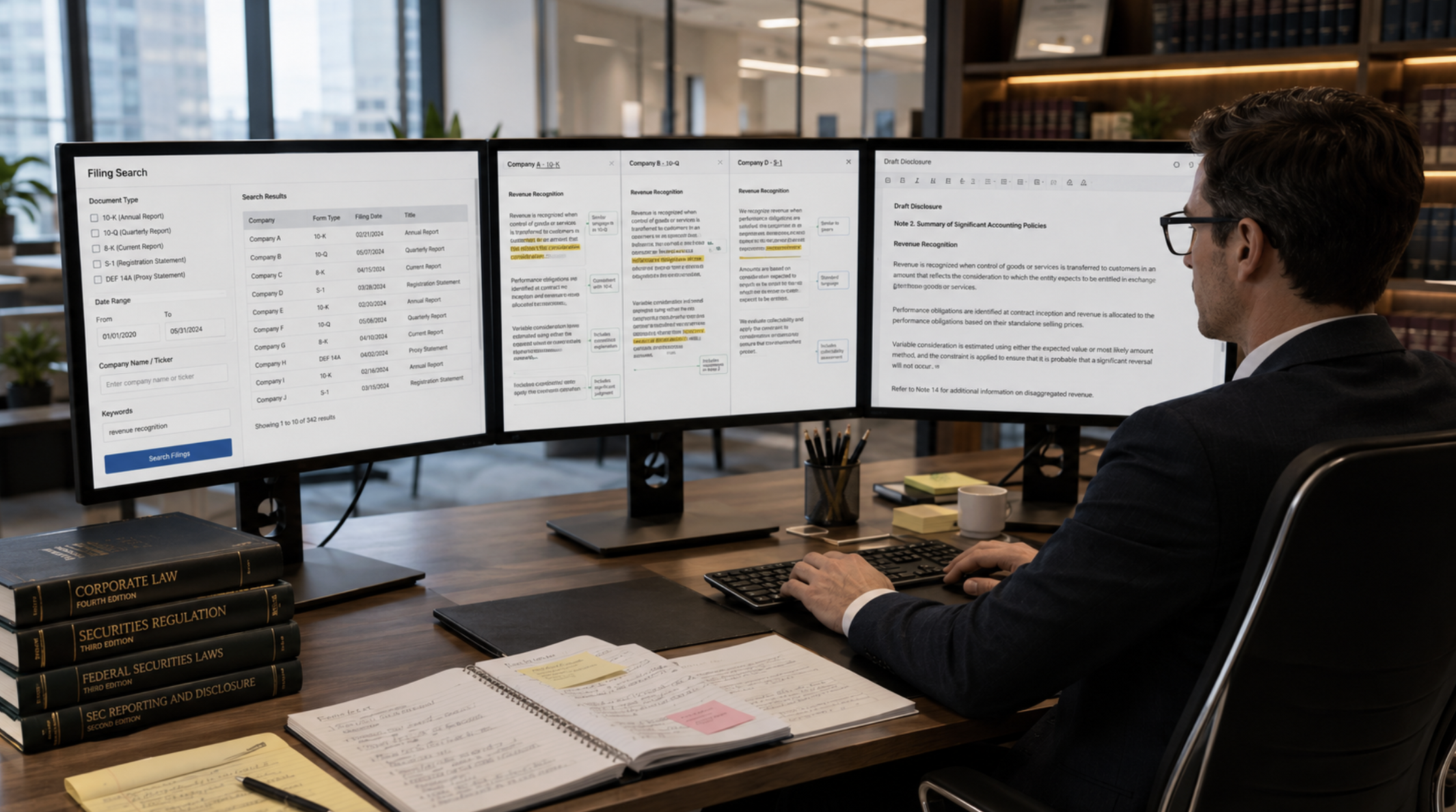
Efficient precedent research relies on a structured EDGAR search process. Legal teams combine EDGAR Full-Text Search (EFTS), form type filters, and company searches to identify relevant SEC precedent filings before drafting or reviewing disclosures.
Use EDGAR Full-Text Search (EFTS)
EDGAR Full-Text Search (EFTS) searches the text of publicly available SEC filings using keywords or phrases. Legal teams use it to locate disclosure language related to topics such as risk factors, executive compensation, material agreements, and corporate governance across multiple filings.
Searching by keywords narrows the number of filings requiring manual review and helps identify disclosures relevant to the reporting issue being researched.
Filter by Form Type
Limit search results to the SEC form you are preparing. Comparing disclosures within the same filing type provides more relevant precedent because each form has different reporting requirements and disclosure objectives.
For example:
- Form 10-K: Annual reports, including Risk Factors and Management's Discussion and Analysis (MD&A)
- Form 8-K: Current reports for material events
- Form S-1: Registration statements for public offerings
Filtering by form type helps legal teams compare filings prepared for similar SEC reporting requirements.
Search Comparable Public Companies
Searching filings from peer public companies provides more relevant precedent than reviewing unrelated issuers. Companies in the same industry often disclose similar business risks, regulatory matters, and transaction-specific information.
Combining company searches with EDGAR Full-Text Search, form type filters, and targeted keywords creates a more focused workflow for researching precedent before drafting or reviewing SEC filings.
A Practical Workflow for Researching SEC Precedent Filings
Legal teams typically follow a structured workflow to identify comparable disclosures before drafting or reviewing SEC filings:
- Define the disclosure. Identify the specific disclosure that requires precedent research before searching EDGAR. For example, a Form 10-K may require research on Risk Factors, Management's Discussion and Analysis (MD&A), or executive compensation. A Form 8-K may focus on a material event, while a Form S-1 may require precedent for business descriptions, risk factors, or offering disclosures.
- Narrow comparable filings. Limit research to filings that match the reporting scenario. Prioritize filings with the same SEC form type, comparable industries or business models, similar reporting obligations or transaction types, and recent filing dates when current disclosure practices are relevant. This produces more relevant SEC precedent filings for comparison.
- Compare disclosure language. Review multiple filings to evaluate how comparable companies structure disclosures, present material information, and describe similar business risks or regulatory requirements. Comparing multiple precedents provides a broader basis for evaluating disclosure approaches than relying on a single filing.
The Limitations of Manual EDGAR Research
EDGAR is the U.S. Securities and Exchange Commission's official repository for public filings, making it the primary source for SEC precedent research. However, conducting precedent research manually can become increasingly time-consuming as legal teams review multiple filings, companies, and reporting periods.
Common challenges include:
- Time-intensive research. EDGAR Full-Text Search (EFTS) helps narrow results by keywords, company name, ticker, CIK, filing type, and other search criteria. Legal teams must still review the results to determine which filings provide the most relevant precedent for the disclosure being drafted.
- Selecting relevant precedent. Search results may include filings from different industries, SEC forms, or reporting periods. Identifying comparable SEC precedent filings requires evaluating whether the disclosure addresses the same reporting requirement, transaction, or business context.
- Version control and traceability. Manual research often involves multiple browser tabs, downloaded filings, and internal working documents. Tracking which precedent was used and maintaining a clear record of supporting source filings becomes more difficult as multiple reviewers contribute to the drafting process.
These challenges do not diminish EDGAR's role as the authoritative source for public filings. Instead, they illustrate the limitations of managing precedent research through manual searches and document review alone, particularly for complex SEC filing workflows.
How Dimension AI Extends EDGAR Research
EDGAR remains the authoritative source for public company filings. Dimension AI extends that research process through precedent-based workflows that extract and structure data from public SEC filings. The platform helps legal teams benchmark, draft, revise, and review SEC documents while maintaining traceability to the original source material.
Automate SEC Precedent Research with Structured Workflows
Manual precedent research often requires multiple EDGAR searches and document reviews before identifying comparable disclosures. Dimension AI streamlines this process by organizing precedent data from public SEC filings into structured workflows for benchmarking, drafting, revision, and review.
Outputs remain traceable to the original SEC filings, allowing legal teams to verify the supporting precedent before incorporating it into a filing. This approach improves research efficiency while maintaining auditability and reducing the risk of unsupported content.
Compare SEC Precedent Filings Side by Side
Dimension AI enables legal teams to compare comparable SEC filings side by side during drafting and review. Reviewing multiple precedents helps evaluate differences in disclosure structure, language, and level of detail across similar filings.
The platform also supports structured review by allowing users to compare changes and accept or reject updates while preserving visibility into the underlying source filings. Legal teams retain control over final disclosure decisions throughout the drafting and review process.
Conclusion: From EDGAR Research to a Structured Precedent Workflow
Knowing how to use EDGAR for SEC filings is an essential part of precedent research. The U.S. Securities and Exchange Commission's EDGAR database provides access to the public filings that legal teams rely on when researching disclosures for Form 10-K, Form 8-K, Form S-1, and other SEC filing types.
The challenge is not accessing filings. It is identifying relevant SEC precedent filings, comparing comparable disclosures, and maintaining traceability throughout drafting and review. A structured workflow helps legal teams conduct precedent research more efficiently while supporting consistent, well-documented SEC filings.
Dimension AI extends EDGAR research through precedent-based workflows that benchmark, draft, revise, and review SEC documents using structured data from public filings. Outputs remain traceable to their original source, allowing legal teams to verify precedent throughout the drafting and review process.
To strengthen your SEC filing workflow, explore our IPO Readiness Checklist for practical guidance on preparing public offerings and our Form N-2 Filing Requirements resource for registered investment fund reporting.
See how Dimension AI turns EDGAR precedent research into a structured workflow
To access this endpoint, you must have an approved developer account, and have activated the new developer portal. When authenticating, you must use keys and tokens from a developer App that is located within a Project. Learn more about getting access to the API v2 endpoints in our "Getting started" page:
Once you have the API v2 collection loaded in Postman
The hide replies endpoint uses OAuth 1.0a user context authentication. If successful, the endpoint hides a single Reply that was published in a Tweet conversation that was initiated by an authenticated user. Each conversation supports hiding up to 725
This endpoint gives you the ability to programmatically hide or unhide replies using criteria you define. Just like the functionality in the main
There are several different tools and libraries that you can use to make a request to this endpoint, but we are going to use the Postman tool here to simplify the process.