Financial services firms increasingly rely on document automation software to manage complex regulatory disclosure workflows while meeting strict filing deadlines. SEC filings, recurring compliance reports, and other regulatory documents require coordinated review across legal, finance, compliance, and investor relations teams. Every revision must reflect approved language, current financial information, and documented approvals to support accurate public company reporting.
Manual document workflows increase operational and compliance risk. Teams often reuse language from prior SEC filings, manually update recurring disclosures, and circulate multiple document versions during review. These processes increase the likelihood of inconsistent disclosures, outdated information, version control failures, and human error. As filing deadlines approach, resolving these issues can delay reviews and increase compliance risk.
Version control is another persistent challenge. Legal, finance, compliance, and investor relations teams may work from different document versions, making it difficult to identify the latest approved draft. Without a complete audit trail, organizations spend additional time validating edits, reconciling comments, and confirming that disclosures remain consistent with internal approvals and prior filings.
For regulated financial services firms, document automation for financial services is about more than improving efficiency. It helps standardize SEC disclosure workflows, reduce repetitive drafting, maintain traceable source information, and support structured review and approval processes. Purpose-built solutions designed for regulatory reporting help organizations improve consistency while preserving the governance, auditability, and compliance controls required for SEC filings.
What Document Automation Software Does
Document automation software helps organizations standardize recurring document workflows through approved templates, automated data population, structured reviews, and version control. Instead of drafting every filing from scratch, teams reuse approved language, populate recurring company information, apply consistent formatting, and route documents through defined review and approval workflows.
For financial services firms, automated document generation software supports more than document creation. It centralizes templates, tracks document versions, and helps legal, finance, compliance, and investor relations teams collaborate on recurring SEC filings and regulatory disclosures. Some platforms also support precedent-based drafting by referencing approved language from prior SEC filings, helping maintain consistency across reporting periods.
Core capabilities include:
- Standardized templates for recurring SEC filings and regulatory documents
- Auto-population of approved company information and recurring disclosures
- Centralized version control and document history
- Structured drafting, review, and approval workflows
- Automated routing to legal, finance, and compliance reviewers
- Consistent formatting across reporting periods
Automation improves efficiency while preserving professional oversight. Legal teams, compliance officers, finance professionals, and executive reviewers remain responsible for validating disclosures and approving final filings. Standardized templates, centralized version history, and structured approval workflows help organizations prepare recurring regulatory documents with greater consistency, governance, and auditability.
These capabilities improve document workflows, but financial services firms require specialized functionality to support SEC disclosure requirements, regulatory compliance, and precedent-based drafting.
Why Financial Services Needs Specialized Document Automation
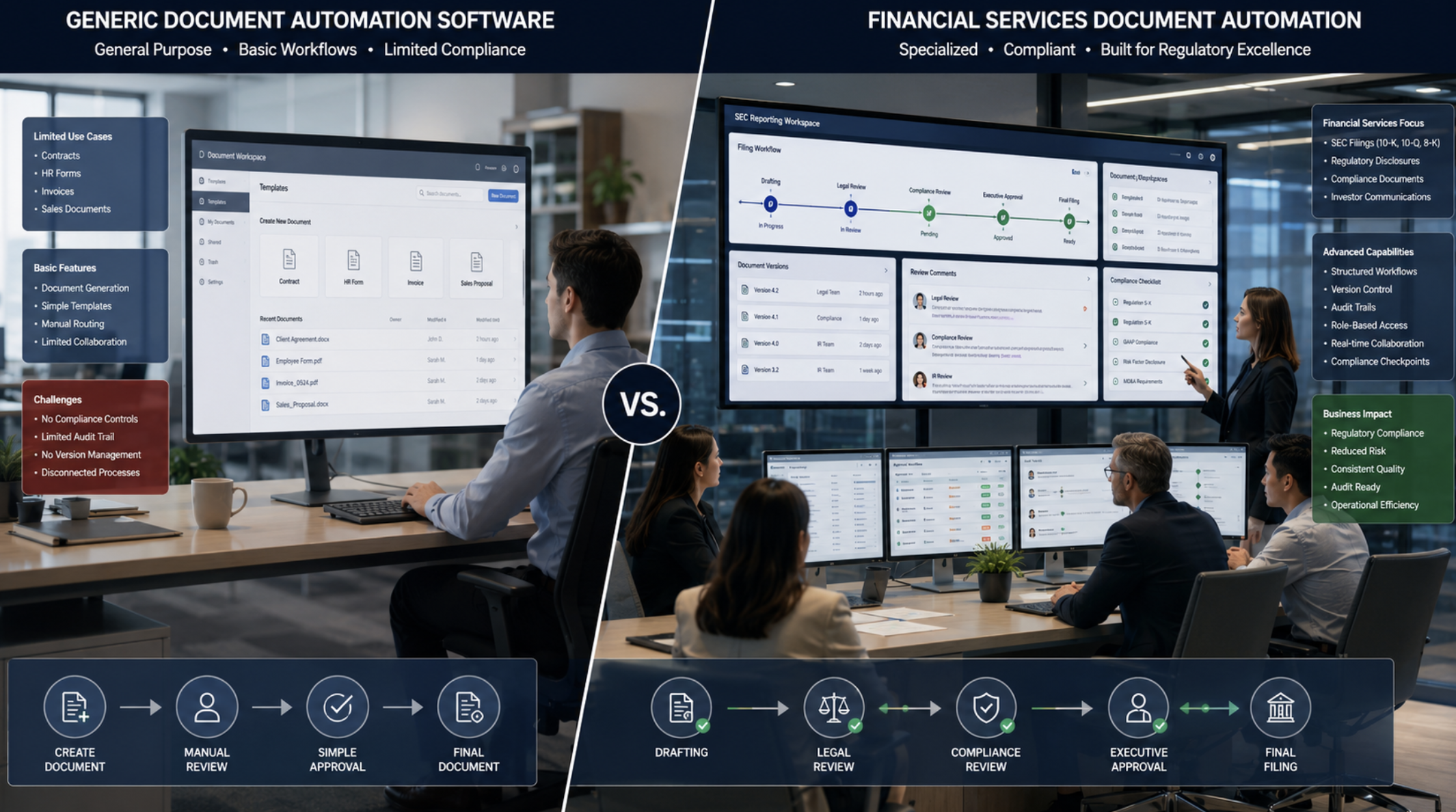
Many document automation platforms are built for contracts, HR forms, and other general business documents. Financial services firms operate under different requirements, where SEC filings and recurring regulatory disclosures must meet strict standards for accuracy, consistency, traceability, and documented approvals. Every revision must withstand internal review and regulatory scrutiny.
Organizations preparing SEC disclosures often coordinate reviews across legal, finance, compliance, investor relations, executive leadership, and external counsel. In addition to SEC requirements, firms may also need to address applicable FINRA rules, PCAOB auditing standards, and internal governance policies. These overlapping obligations make document workflows significantly more complex than standard business documentation.
Generic document automation can improve drafting efficiency, but it typically does not support the regulatory context required for public company reporting. Financial services firms need workflows that help teams:
- Maintain consistent disclosure language across reporting periods.
- Track version history and reviewer approvals.
- Support structured review processes before filing.
- Preserve traceable records for governance and audit readiness.
These requirements are why document automation for financial services differs from general-purpose automation. Purpose-built solutions support SEC disclosure workflows with standardized templates, compliance-focused review processes, comprehensive version history, and precedent-based drafting that helps maintain consistency across recurring filings. Organizations evaluating SEC filing software should prioritize platforms designed for regulatory reporting rather than general document generation.
Preparing regulatory documents is not simply about producing documents faster. It requires repeatable workflows that strengthen governance, improve collaboration, and reduce compliance risk throughout the filing lifecycle. The next step is understanding which capabilities matter most when evaluating document automation software for regulated financial services firms.
Six Features to Look for in Document Automation Software
Not all document automation software is designed for regulated financial environments. Financial services firms should evaluate whether a platform supports SEC disclosure workflows, auditability, and compliance requirements. When evaluating document automation for SEC filings, prioritize capabilities that strengthen governance while reducing manual effort.
1. SEC-Specific Template Library
Recurring filings such as Form 10-K, Form 10-Q, Form 8-K, and Form S-1 follow established disclosure structures. An SEC-specific template library helps teams begin with approved document frameworks instead of recreating filings or relying on outdated versions.
Standardized templates improve consistency across reporting periods while supporting controlled disclosure workflows.
2. Full Audit Trail and Version History
Regulatory reporting requires complete visibility into document changes. A comprehensive audit trail records revisions, reviewer activity, approvals, and version history, making it easier to verify who changed a document and when.
Strong version control supports governance, compliance reviews, and collaboration across legal, finance, compliance, and investor relations teams.
3. Precedent-Based Language Suggestions
Financial disclosures frequently build on previously approved language. Precedent-based language suggestions reference historical filings to support consistent drafting while preserving reviewer oversight.
Source-backed recommendations help legal and compliance teams evaluate updates with greater confidence because proposed language can be traced to prior disclosures.
4. Approval Workflow Integration
SEC filings typically require review by legal, finance, compliance, executive leadership, investor relations, and, where applicable, external counsel. Structured approval workflows route documents through these established review stages while maintaining documented approvals and accountability.
5. XBRL and iXBRL Compatibility
Many SEC filings include structured financial data prepared using XBRL or iXBRL. Organizations evaluating document automation software should consider whether a platform supports structured reporting workflows that improve filing readiness and reduce manual formatting.
6. SOC 2 Certification and Data Security
Regulatory documents often contain confidential financial information and material non-public information. Evaluate security capabilities such as SOC 2 compliance, enterprise authentication, secure access controls, and responsible data handling to help protect sensitive information throughout drafting, review, and approval.
Feature Comparison
| Feature | Why It Matters for Financial Services |
|---|---|
| SEC-Specific Template Library | Standardizes recurring SEC disclosures and improves consistency across reporting periods. |
| Full Audit Trail and Version History | Records document changes and approvals to strengthen governance and compliance. |
| Precedent-Based Language Suggestions | Supports traceable, source-backed drafting using approved disclosure language. |
| Approval Workflow Integration | Maintains structured legal, finance, compliance, and executive review processes. |
| XBRL and iXBRL Compatibility | Supports structured financial reporting workflows associated with SEC filings. |
| SOC 2 Certification and Data Security | Protects confidential financial information through enterprise security controls. |
These capabilities become even more valuable in recurring SEC disclosure workflows, where accuracy, traceability, and auditability are essential to filing readiness.
Common Use Cases for Financial Services Firms
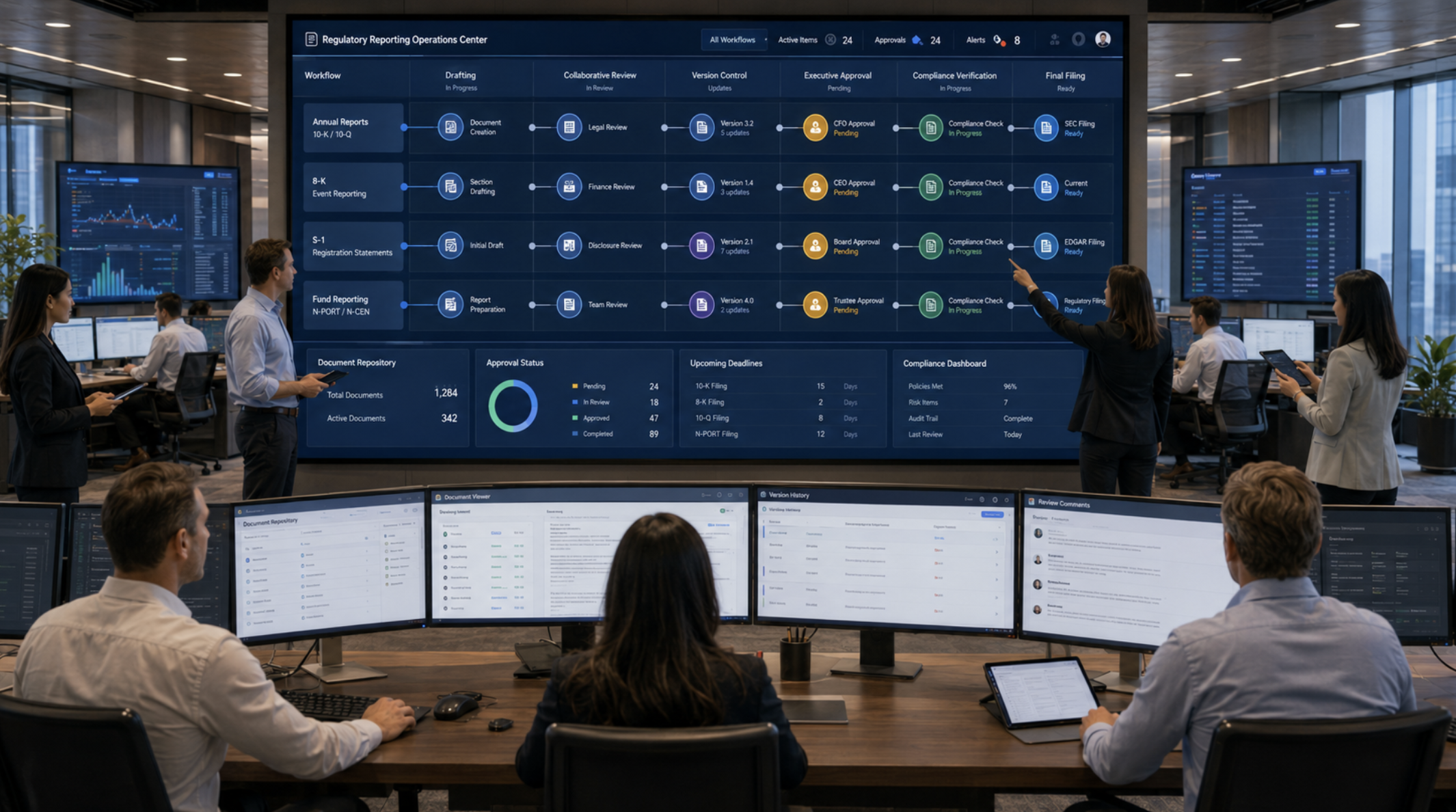
Financial services firms prepare recurring SEC disclosures that require coordinated reviews, documented approvals, and consistent regulatory language. Document automation software helps standardize these workflows, reduce repetitive drafting, and improve filing readiness across reporting cycles.
Annual Report Preparation (Form 10-K and Form 10-Q)
Preparing Form 10-K and Form 10-Q filings requires coordination across legal, finance, compliance, investor relations, and executive leadership. Because many disclosures carry forward between reporting periods, standardized templates, precedent-based drafting, and centralized version history help teams update recurring content while maintaining consistency and reviewer oversight.
8-K Event Reporting
Form 8-K filings often follow material events that require timely public disclosure. Under compressed filing timelines, manual document coordination can delay reviews and increase version control challenges.
Purpose-built document automation software helps teams organize drafting, route documents through predefined approval workflows, and maintain a single, traceable working version. This supports faster disclosure preparation while preserving governance and accountability.
S-1 Registration Statements
Preparing a Form S-1 registration statement involves extensive disclosures, multiple review cycles, and coordination among internal teams and external advisors. As revisions accumulate, maintaining document consistency and version control becomes increasingly difficult.
Specialized document automation for financial services supports standardized drafting, document history, and precedent-based language suggestions that help maintain consistency throughout the registration process.
Fund Reporting
Investment managers and other financial services firms regularly prepare recurring fund reports that follow established regulatory requirements. Standardized templates, structured reviews, and approved disclosure language help reduce repetitive drafting while improving consistency across reporting periods.
Organizations preparing Form N-2 filings and other recurring investment company disclosures benefit from repeatable workflows that strengthen governance, maintain version control, and reduce manual document management.
Measuring the ROI of Document Automation Software
The return on investment from document automation software comes from reducing the time and administrative effort required to prepare recurring SEC disclosures. Instead of spending hours updating prior filings, reconciling document versions, and coordinating manual reviews, legal, finance, compliance, and investor relations teams can work from standardized workflows that improve filing readiness.
Preparing Form 10-K, Form 10-Q, Form 8-K, and other regulatory filings often involves updating recurring disclosures, validating revisions, routing documents for approval, and confirming that every stakeholder is reviewing the latest approved version. These manual activities add time to every filing cycle without improving disclosure quality.
Purpose-built document automation for financial services reduces this operational burden by centralizing approved templates, maintaining version history, supporting structured review workflows, and preserving traceable approval records. This allows subject matter experts to focus on reviewing disclosures, resolving material issues, and meeting filing deadlines instead of managing document logistics.
Operational improvements may include:
- Less manual drafting for recurring SEC filings
- Fewer document version conflicts
- Shorter review and approval cycles
- Better coordination across legal, finance, compliance, and investor relations
- More consistent disclosures across reporting periods
- Lower administrative effort throughout each filing cycle
The long-term value extends beyond faster drafting. Organizations that standardize recurring disclosure workflows spend less time resolving process issues and more time preparing accurate, auditable filings that support regulatory compliance.
How Dimension AI Approaches Document Automation for Financial Services
Many document automation platforms focus on improving document creation. Dimension AI is designed specifically for SEC disclosure workflows, where accuracy, auditability, and regulatory oversight are essential.
Instead of relying on unrestricted AI-generated text, Dimension AI uses precedent-based workflows that reference historical SEC filings and approved disclosure language. This helps legal, finance, and compliance teams evaluate suggested content with traceable sources while maintaining reviewer control throughout the drafting process.
The platform supports recurring SEC reporting by standardizing drafting, preserving document history, and enabling structured review workflows. Compliance guardrails, auditability, and traceable source references help organizations manage disclosure preparation without compromising governance or professional oversight.
This approach reflects how public companies prepare regulatory filings. Rather than replacing legal or compliance professionals, Dimension AI reduces repetitive drafting while supporting informed review and approval decisions based on established regulatory disclosures.
For organizations evaluating document automation for SEC filings, the objective extends beyond faster document creation. Purpose-built workflows help improve consistency across recurring disclosures, strengthen governance, and reduce manual effort while preserving the transparency required for SEC reporting.
Conclusion: Choosing the Right Document Automation Software
Selecting document automation software for financial services requires more than comparing productivity features. Organizations should evaluate whether a platform supports SEC disclosure workflows with structured review processes, precedent-based drafting, auditability, and compliance guardrails that strengthen governance throughout every filing cycle.
Purpose-built solutions help legal, finance, compliance, and investor relations teams standardize recurring disclosures, reduce repetitive manual work, and maintain reviewer oversight without compromising accuracy. When evaluating long-term fit, prioritize platforms that improve consistency, preserve traceable source references, and support repeatable regulatory workflows designed for public company reporting.
Schedule a demo to see document automation built for SEC disclosure.
To access this endpoint, you must have an approved developer account, and have activated the new developer portal. When authenticating, you must use keys and tokens from a developer App that is located within a Project. Learn more about getting access to the API v2 endpoints in our "Getting started" page:
Once you have the API v2 collection loaded in Postman
The hide replies endpoint uses OAuth 1.0a user context authentication. If successful, the endpoint hides a single Reply that was published in a Tweet conversation that was initiated by an authenticated user. Each conversation supports hiding up to 725
This endpoint gives you the ability to programmatically hide or unhide replies using criteria you define. Just like the functionality in the main
There are several different tools and libraries that you can use to make a request to this endpoint, but we are going to use the Postman tool here to simplify the process.