XBRL and Inline XBRL (iXBRL) tagging is one of the highest-risk steps in the SEC reporting process. Small tagging errors can create broken calculations, Data Quality Committee (DQC) rule failures, EDGAR rejection notices, and costly re-filings. Since iXBRL became mandatory for SEC filings, xbrl tagging software and ixbrl tagging software now sit on the critical path of nearly every 10-K and 10-Q workflow.
EDGAR Next has added another layer of operational complexity by moving authentication and submission controls deeper into the filing process. The best xbrl tagging software for SEC filings now needs to support tagging accuracy, continuous validation, EDGAR readiness, auditability, and workflow control inside compressed reporting timelines. This guide compares leading xbrl tagging software platforms across validation workflows, EDGAR Next readiness, workflow fit, AI capabilities, security controls, pricing structure, and review processes for SEC reporting teams.
What XBRL Tagging Software Actually Does
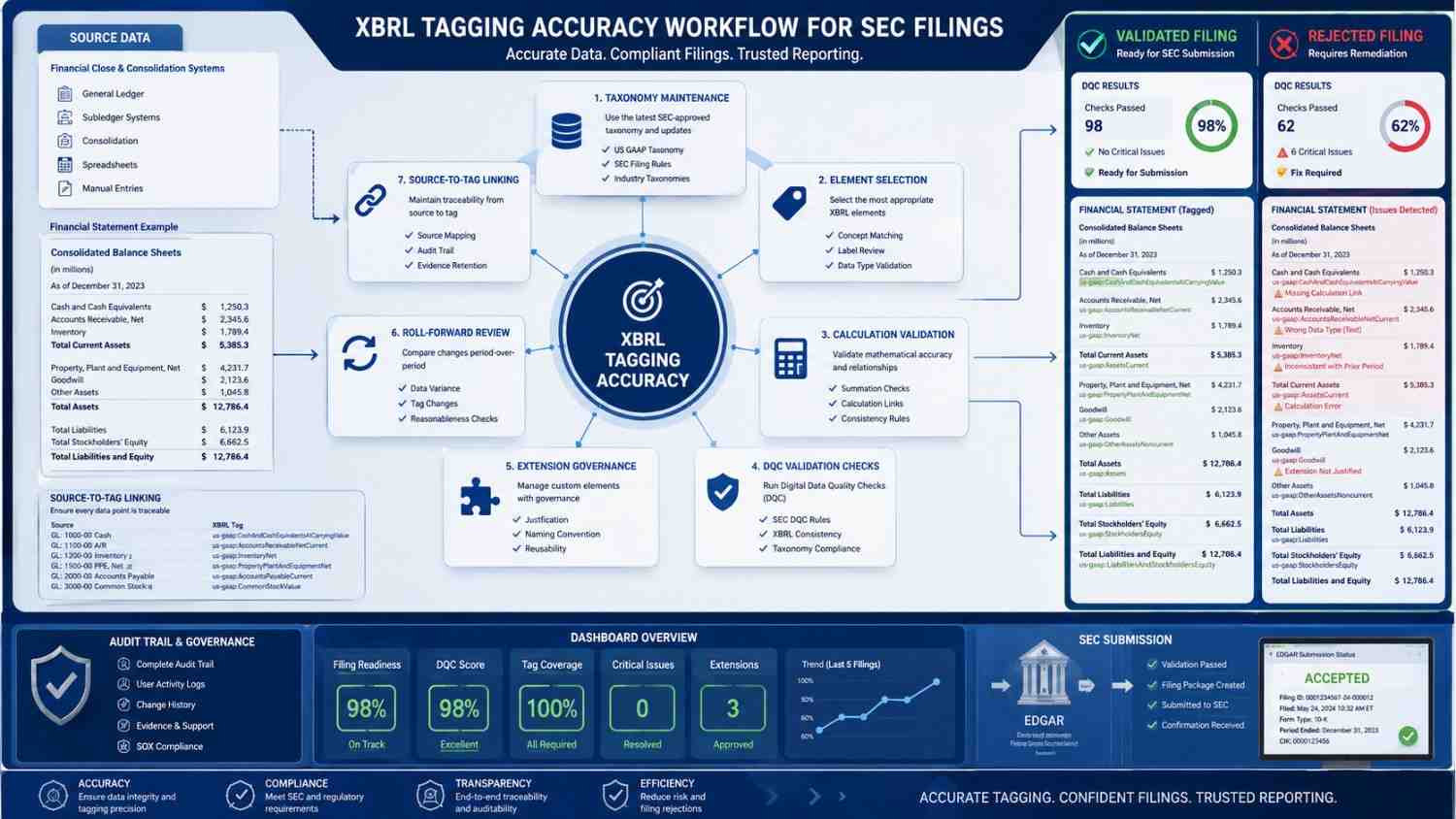
XBRL tagging software applies structured reporting concepts from a published taxonomy to financial statements, footnotes, tables, and narrative disclosures. In SEC reporting, those taxonomies typically include the US GAAP taxonomy and SEC reporting taxonomies. International workflows may also involve ESEF or UKSEF frameworks.
Inline XBRL (iXBRL) embeds machine-readable XBRL tags directly into a human-readable HTML filing. The tagging workflow typically includes mapping disclosures to taxonomy concepts, validating calculations and filing structure, and generating a submission-ready EDGAR HTML or iXBRL filing.
The market generally falls into three workflow categories:
- Standalone tagging tools — Platforms focused primarily on tagging and validation workflows. This category includes IRIS CARBON, Lucanet XBRL Tagger, DataTracks Rainbow, Ez-XBRL, Altova, and the open-source validation engine Arelle.
- Disclosure management suites with integrated tagging — Platforms such as Workiva, DFIN ActiveDisclosure, Toppan Merrill Bridge, and Certent combine drafting, collaboration, review, and tagging inside a broader SEC reporting workflow.
- AI-assisted drafting and review upstream of tagging — Platforms such as Dimension AI are not tagging engines. Instead, they reduce the volume of late-cycle drafting changes the tagging workflow must absorb during 10-K, 10-Q, and capital markets filing cycles.
Teams evaluating the best XBRL tagging software should look beyond filing output alone. Validation workflows, roll-forward accuracy, auditability, and late-stage change management often determine whether a filing cycle remains controlled under deadline pressure.
Tagging Accuracy: What "Good" Looks Like
Tagging accuracy is not a single feature. It is the cumulative result of taxonomy maintenance, validation controls, reviewer judgment, and workflow discipline.
SEC reporting teams evaluating the best XBRL tagging software should review six core accuracy areas:
- Taxonomy currency — The platform should keep US GAAP and SEC reporting taxonomies current without manual filer intervention.
- Element selection — Strong XBRL tagging software for SEC filings helps users select the most precise taxonomy concept instead of relying on broad or "close enough" mappings.
- Calculation linkbase integrity — A calculation linkbase defines how tagged financial facts relate mathematically inside the filing. Totals should tie correctly, debit-credit signs should remain consistent, and the filing should validate cleanly.
- Custom extension hygiene — Custom extensions should only be created when no standard taxonomy element accurately reflects the disclosure.
- Roll-forward fidelity — Prior-period tags should carry forward without silently inheriting prior-year tagging errors.
- Source-to-tag linking — When source values change because of auditor edits or disclosure revisions, the related tags should update immediately across the filing workflow.
For SEC reporting teams, tagging accuracy is ultimately a workflow outcome rather than a standalone feature. Strong review controls and continuous validation usually matter more than isolated automation features.
Validation: Arelle, DQC, and the EDGAR Pre-Flight
Validation is one of the clearest differentiators between mature and immature XBRL validation software. SEC reporting teams should expect four validation layers inside the filing workflow:
- Arelle validation — Arelle is an open-source XBRL processor widely treated as the regulator-grade validation standard. Best-in-class XBRL tagging software platforms integrate Arelle directly for taxonomy, calculation, and filing-structure validation.
- DQC validation — The Data Quality Committee (DQC) publishes rules designed to identify common SEC filing-quality issues. Strong iXBRL tagging software runs DQC checks continuously during the tagging process rather than only at the end of the filing cycle.
- EDGAR pre-flight validation — SEC filings must pass EDGAR technical submission rules before acceptance. Good EDGAR XBRL software performs pre-flight validation against EDGAR requirements before submission.
- Preview mode — A true filing-ready preview shows how the document will render inside EDGAR before filing. Preview-only-at-the-end workflows often create unnecessary late-cycle surprises.
Continuous validation during tagging is generally safer than end-of-cycle validation, which many SEC reporting teams treat as a high-stakes gamble during compressed filing windows. Strong SEC XBRL software surfaces broken calculations, missing tags, presentation inconsistencies, and DQC failures earlier in the workflow instead of immediately before submission.
Schema note: Apply HowTo schema to this section.
SEC Filing Workflow Fit: 10-K, 10-Q, 8-K, S-1, 424(b)
Different SEC filing types create different tagging pressures inside the reporting workflow.
- 10-K — Annual reports create the heaviest tagging workload. These filings require full taxonomy coverage, footnote and narrative tagging, custom extensions, calculation linkbase management, and multi-week audit trails.
- 10-Q — Quarterly reports place greater pressure on speed, comparability, and rapid roll-forward workflows.
- 8-K — Form 8-K filings have a narrower tagging scope, but compressed four-business-day timelines increase operational pressure during review and submission.
- S-1, S-3, and 424(b) — Capital markets filings rely heavily on precedent reuse across disclosure structures, tables, and tagging patterns.
- DEF 14A — Proxy filings introduce narrative-heavy workflows alongside pay-versus-performance tagging requirements.
In practice, tagging is often the final critical-path step before submission. Late drafting edits and auditor revisions flow downstream into the tagging workflow. Platforms that support source-to-tag linking, instant preview re-rendering, and continuous validation can materially reduce deadline pressure.
Upstream AI-assisted drafting and review workflows can also reduce tagging exposure. Dimension AI uses precedent-based workflows with traceable sources to reduce late-cycle drafting changes before submission. The platform reports 10+ hours saved per 424(b) transaction and 15+ hours per annual report workflow through precedent-based drafting and review workflows that preserve auditability and source traceability.
EDGAR Next and What It Means for Your Tool
EDGAR Next changes how authentication, access controls, and submission authority operate inside SEC filing workflows. Authentication is no longer separate from the filing process itself. Submission permissions, identity verification, and credential governance now sit directly inside operational reporting workflows.
As a result, SEC XBRL software now requires stronger controls around permissions, reviewer access, and submission authority. Best-in-class EDGAR XBRL software integrates EDGAR Next authentication directly into the filing workflow so the right users maintain submission authority at the right stage of the reporting cycle without last-minute credential escalations.
Buyers evaluating the best XBRL tagging software for SEC reporting 2026 should ask vendors several operational questions:
- How are submission permissions managed during active filing cycles?
- Does the platform support role-based access controls?
- How are MFA and SSO workflows integrated?
- What is the vendor's EDGAR Next migration timeline?
- How are audit trails maintained for credential and submission actions?
EDGAR Next readiness is now a core workflow consideration rather than a standalone IT issue. It directly affects filing coordination, review timing, and governance controls during compressed reporting windows. Many existing XBRL filing software comparisons still underweight EDGAR Next operational readiness despite it becoming one of the clearest 2026 differentiators in SEC reporting workflows.
Comparison: Leading XBRL Tagging Tools for SEC Filings
The SEC XBRL software market now includes disclosure management suites, specialist tagging platforms, open-source validation tools, and upstream AI-assisted drafting and review workflows. The right fit depends on filing complexity, review structure, validation requirements, and operational workflow design.
| Platform | Category | Validation & Accuracy | EDGAR Next / Workflow | AI & Review Features | Pricing Model |
|---|---|---|---|---|---|
| Workiva | Disclosure management suite | Integrated iXBRL tagging and collaborative validation workflows | Broad SEC, SOX, and ESG reporting workflows | AI-assisted workflow features | Enterprise subscription |
| DFIN ActiveDisclosure | Disclosure management suite | Intelligent iXBRL workflows with integrated tagging | Filing-agent infrastructure and SEC submission workflows | Active Intelligence AI functionality | Enterprise subscription |
| Toppan Merrill Bridge | Disclosure management suite | Integrated XBRL workflows; company references XBRL US DQC leadership and 3M+ XBRL tags annually | Ownership reporting and disclosure management workflows | Workflow automation features | Enterprise subscription |
| Certent Disclosure Management | Disclosure management suite | Multi-taxonomy support across US GAAP, IFRS, and ESEF | Office-integrated collaborative reporting workflows | Structured reporting support | Enterprise subscription |
| Lucanet XBRL Tagger | Disclosure management / tagging platform | Automated calculation linkbase support | Cloud-native tagging workflows | Tagger Agent AI for narrative and table tagging | Enterprise subscription |
| IRIS CARBON | Specialist tagging platform | Arelle integration and direct source-to-tag linking | EDGAR Next authentication support | AI-assisted roll-forward workflows | Per-filing pricing common |
| DataTracks Rainbow | Specialist tagging platform | SEC and global tagging workflows | Filing-focused tagging operations | Workflow-focused tooling | Per-filing pricing common |
| Ez-XBRL | Specialist tagging platform | SEC-focused tagging workflows | Filing and validation workflows | Limited AI positioning | Per-filing pricing common |
| Arelle | Open-source validation engine | Open-source regulator-grade validation engine | Embedded across many vendor validation stacks | No drafting layer | Free open source |
| Altova XBRL Tagging Solution | Open-source / free tooling | Cloud-based visual tagging support for US GAAP and ESEF | Visual tagging workflows | No major AI positioning | Free public beta availability |
| Dimension AI | AI-assisted drafting and review layer | Upstream drafting and review workflows that reduce late-cycle tagging changes | Sits upstream of tagging and submission workflows | Precedent-based workflows with traceable sources, zero hallucination risk, auditable and verifiable outputs | AI-assisted workflow pricing |
Enterprise tagging modules are typically bundled inside broader disclosure management subscriptions, with publicly reported market ranges commonly falling between roughly $2,000 and $25,000 per month. Specialist XBRL filing software platforms are often priced per filing, with market ranges commonly between roughly $500 and $5,000 per disclosure depending on workflow scope and support requirements.
Dimension AI is not a tagging engine. The platform operates upstream of tagging and review workflows to reduce the volume of late-cycle drafting changes that tagging teams must absorb. Fewer late-stage disclosure revisions generally create fewer downstream re-tagging cycles during compressed SEC reporting windows.
Reviewing iXBRL Filings: Where Bottlenecks Hide
Most iXBRL review bottlenecks appear late in the filing cycle, when disclosure edits, auditor revisions, and validation issues converge inside compressed submission windows.
Common bottlenecks include:
- Late-stage taxonomy concept changes — Auditor edits or revised disclosure language can force concept remapping and additional validation review late in the process.
- Narrative and footnote tag drift — Footnote and narrative tags can become misaligned with source disclosures after late paragraph rewrites or multi-team review cycles.
- Custom extension proliferation — Unnecessary or inconsistent custom extensions are often discovered shortly before filing deadlines.
- End-of-cycle DQC failures — Data Quality Committee (DQC) rule failures surfaced only at final validation can create operational disruption and rework pressure.
- Preview-only-at-the-end review patterns — Teams that review EDGAR rendering only before submission often discover formatting or presentation issues too late.
Operationally, the fix is usually workflow-oriented rather than feature-oriented. Continuous validation, source-to-tag linking, role-based review queues, attributed audit trails, and true preview functionality reduce the likelihood of late-stage filing disruptions.
AI-assisted review workflows can also reduce downstream tagging pressure. Dimension AI uses precedent-based workflows with traceable sources to identify disclosure changes earlier in the drafting and review process. Outputs are auditable and verifiable, and every output can be audited back to its source before changes reach the tagging workflow.
Schema note: Apply HowTo schema to this section.
AI in XBRL Tagging: What It Helps and What It Cannot Replace
AI functionality is becoming more common inside SEC reporting workflows, but its operational value depends on where it is applied.
Inside XBRL tagging software, AI currently works best in several narrow workflow areas:
- Roll-forward support — AI-assisted workflows can map prior-period tags into updated filings and identify structural changes requiring additional review.
- Element suggestion — Some iXBRL tagging software platforms surface candidate taxonomy concepts for a given fact or disclosure.
- Consistency review — AI can help identify tags that drift from prior filings, peer practice, or existing reporting patterns.
AI does not replace human review for novel disclosures, judgment-heavy accounting issues, taxonomy interpretation, or custom extension decisions. SEC XBRL software still depends on reviewer judgment, validation controls, and disciplined audit workflows.
There is also an important distinction between AI-assisted tagging and AI-assisted drafting upstream of tagging. Generative AI creates new text and can introduce hallucination risk or unsupported disclosure language. Precedent-based AI extracts and structures verbatim language from public EDGAR filings with traceable citations.
Dimension AI uses precedent-based workflows with traceable sources rather than probabilistic text generation. The platform emphasizes zero hallucination risk and auditable and verifiable workflows where every output can be audited back to its source. For SEC reporting teams, that distinction matters because unsupported filing language creates governance and compliance risk inside the tagging and review process.
Security, Audit Trail, and Pricing
Security and governance reviews are now standard parts of SEC XBRL software evaluation.
Buyers should evaluate SOC 1 and SOC 2 controls, encryption standards, role-based access controls, audit-log retention, and MFA or SSO support aligned with EDGAR Next workflows. Auditability also matters operationally. SEC reporting teams should be able to trace who changed a disclosure, when the change occurred, and how the change affected validation results.
For AI-enabled workflows, buyers should review training-data policies, retention controls, and hosting infrastructure. Dimension AI maintains zero data retention policies, supports Azure Private Cloud and Azure Public Cloud deployment environments, and we never train external AI models on your data.
Pricing structures vary across the XBRL filing software market:
- Disclosure management suites commonly bundle tagging inside broader reporting subscriptions, with publicly reported market ranges often between roughly $2,000 and $25,000 per month.
- Specialist tagging platforms commonly use per-filing pricing, often ranging from roughly $500 to $5,000 per disclosure.
- Services-led tagging workflows may charge separately for validation, review, or filing support.
- Arelle and portions of Altova's offering remain free.
- AI add-on pricing is still emerging and is typically usage-based or per-seat.
For SEC reporting teams, total cost of ownership is usually more important than headline subscription pricing alone. Software, validation workflows, training, AI add-ons, and external filing support all affect long-term operating cost.
Buyer Checklist: How to Choose
Choosing the best XBRL tagging software starts with understanding the reporting workflow itself.
SEC reporting teams should evaluate platforms using a practical workflow checklist:
- Map the next three years of filing volume by form type, including 10-Ks, 10-Qs, 8-Ks, 424(b)s, and other specialized disclosures.
- Identify the tagging model: internal, services-led, or hybrid.
- Score each shortlisted vendor against accuracy, validation, EDGAR Next readiness, source-to-tag linking, roll-forward workflows, preview functionality, audit trails, AI capabilities, security controls, and pricing structure.
- Run a live pilot on a real filing rather than a sandbox workflow.
- Evaluate AI-assisted drafting and review layers separately from the tagging engine itself using the issuer's own precedent set.
- Confirm data-handling, retention, and training-policy commitments in writing.
- Require customer references within the same filing segment and reporting complexity level.
For most issuers, the best XBRL tagging software for SEC reporting 2026 will be the platform that reduces operational risk while fitting the company's actual reporting workflow, staffing structure, and review process.
Schema note: Apply HowTo schema to this section.
Frequently Asked Questions
What is the best XBRL tagging software for SEC filings in 2026?
The best XBRL tagging software depends on filing complexity, review structure, and operational workflow requirements. Large SEC reporting teams often evaluate disclosure management suites such as Workiva, DFIN ActiveDisclosure, Toppan Merrill Bridge, or Certent because tagging sits inside a broader reporting workflow. Teams focused on specialist tagging workflows may compare IRIS CARBON, Lucanet XBRL Tagger, DataTracks Rainbow, or Ez-XBRL.
For 2026, buyers are increasingly prioritizing EDGAR Next readiness, continuous validation, source-to-tag linking, and auditability rather than feature volume alone.
What is the difference between XBRL and iXBRL tagging software?
XBRL tagging software creates machine-readable financial reporting data using structured taxonomies such as the US GAAP taxonomy. Inline XBRL (iXBRL) embeds those tags directly into a human-readable HTML filing.
For US SEC filers, iXBRL is now the standard filing format for 10-K and 10-Q workflows. Most modern XBRL filing software supports both XBRL validation and iXBRL rendering inside the same workflow.
How is XBRL tagging accuracy measured?
Tagging accuracy is measured through several operational controls working together. Tagging accuracy is typically evaluated through taxonomy currency, element-selection precision, calculation linkbase integrity, custom extension discipline, roll-forward quality, and DQC validation results.
The best XBRL tagging software also supports source-to-tag linking so updates in source financials flow directly into tagged data during the review process.
What is Arelle and why does it matter for SEC filings?
Arelle is an open-source XBRL processor widely used as a validation engine for SEC filings. Many commercial XBRL validation software platforms integrate Arelle directly because it supports regulator-grade validation checks for taxonomies, calculations, and filing structure.
Continuous validation using Arelle and DQC rules is generally safer than discovering filing issues immediately before EDGAR submission.
How does EDGAR Next change XBRL tagging software requirements?
EDGAR Next changes how authentication, access control, and submission authority operate inside SEC filing workflows. Filing teams now need stronger role-based permissions, MFA and SSO support, and tighter auditability around submission authority.
As a result, EDGAR Next readiness has become a major evaluation factor for SEC XBRL software and EDGAR XBRL software workflows in 2026.
Does AI-assisted drafting replace XBRL tagging software?
No. AI-assisted drafting does not replace iXBRL tagging software, taxonomy validation, or human review workflows.
Where AI currently helps is upstream of tagging. Dimension AI uses precedent-based workflows with traceable sources to reduce late-stage drafting changes before they reach the tagging process. The platform emphasizes zero hallucination risk and auditable and verifiable workflows where every output can be audited back to its source.
Closing Thoughts
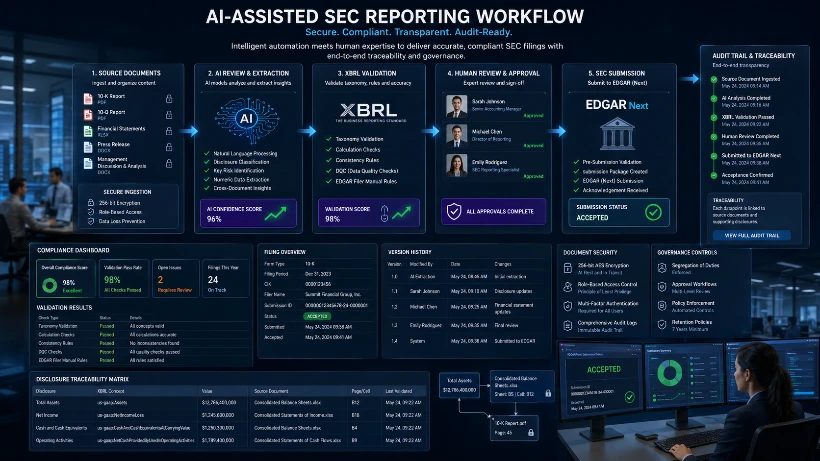
The best XBRL tagging software reduces operational risk during compressed SEC reporting cycles. Accuracy, continuous validation, EDGAR readiness, auditability, and workflow control generally matter more than feature count alone.
As EDGAR Next and AI-assisted review workflows become part of standard SEC reporting operations, buyers should evaluate platforms based on validation discipline, governance controls, and workflow fit across recurring 10-K and 10-Q cycles.
See how a precedent-based AI layer can sit upstream of your XBRL tagging workflow — every draft cited, every change auditable, no client data used to train external models. Request access.
To access this endpoint, you must have an approved developer account, and have activated the new developer portal. When authenticating, you must use keys and tokens from a developer App that is located within a Project. Learn more about getting access to the API v2 endpoints in our "Getting started" page:
Once you have the API v2 collection loaded in Postman
The hide replies endpoint uses OAuth 1.0a user context authentication. If successful, the endpoint hides a single Reply that was published in a Tweet conversation that was initiated by an authenticated user. Each conversation supports hiding up to 725
This endpoint gives you the ability to programmatically hide or unhide replies using criteria you define. Just like the functionality in the main
There are several different tools and libraries that you can use to make a request to this endpoint, but we are going to use the Postman tool here to simplify the process.