Best SEC Filing Software for AI-Assisted Drafting and Review
SEC filing is one of the highest-risk and highest-effort document workflows inside a public company. A single reporting cycle can involve finance, legal, investor relations, external auditors, disclosure committees, EDGAR validation, and compressed submission timelines across 10-Ks, 10-Qs, 8-Ks, S-1s, proxies, 424(b)s, and fund annual reports. That complexity is why the market for the best sec filing software has expanded beyond basic submission tools into broader drafting, review, and governance workflows.
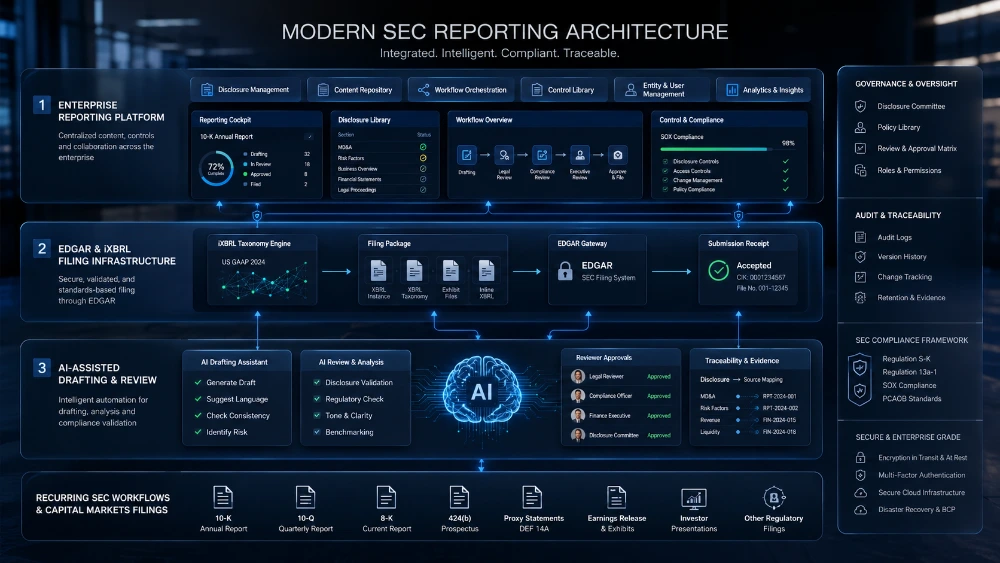
Today, most sec filing software falls into three categories: enterprise reporting suites, EDGAR and iXBRL filing infrastructure, and AI-assisted drafting and review tools. The right platform depends less on feature count and more on workflow fit, filing complexity, governance requirements, and review controls. This guide compares sec reporting software across those categories, including workflow coverage, AI-assisted review, EDGAR and iXBRL capabilities, security controls, pricing structure, and operational fit for different SEC reporting teams.
The SEC Filing Software Market: Three Layers
The sec reporting software market is no longer a single category. Most public companies now operate across multiple software layers, each solving a different part of the disclosure process.
Enterprise Reporting Suites
Enterprise reporting platforms act as the operational center of the filing process. Platforms such as Workiva, DFIN ActiveDisclosure, Toppan Merrill Bridge, and Certent Disclosure Management support collaborative drafting, end-to-end disclosure management, XBRL and iXBRL tagging, review routing, EDGAR submission workflows, and broader governance, risk, and compliance processes.
These platforms typically become the system of record for recurring reporting obligations. They centralize linked financial data, maintain version control across contributors, and support workflows spanning SEC reporting, SOX compliance, ESG reporting, and internal governance reviews.
Workiva is widely used by large public companies that want a unified environment across SEC, SOX, and ESG workflows. DFIN ActiveDisclosure is known for Excel-linked drafting and integrated XBRL tagging. Toppan Merrill Bridge emphasizes Microsoft Office-style familiarity alongside ownership reporting workflows for Section 16, 13D/G, and 13F filings. Certent Disclosure Management is commonly positioned for organizations managing multi-taxonomy reporting across US GAAP, IFRS, and ESEF requirements.
EDGAR and iXBRL Filing Infrastructure
A second layer focuses directly on filing mechanics, validation, and taxonomy processing. This includes full-service filing agents, EDGAR validation workflows, and specialized XBRL tooling.
In this category, accuracy is non-negotiable. SEC filing teams need current taxonomies, pre-flight validation checks, exhibit management, and submission controls that align with EDGAR requirements. Even small tagging or formatting errors can delay filings or trigger review issues during submission windows.
Arelle is one of the better-known open-source XBRL processing tools in this space. Many filing teams and vendors use it for taxonomy validation and structured reporting workflows. Filing agents also continue to play a major operational role for issuers that need hands-on submission support during high-pressure filing cycles.
AI-Assisted Drafting and Review
The newest category focuses on drafting acceleration and review compression. Instead of replacing filing systems, these tools sit upstream in the workflow and help teams reduce manual drafting, precedent review, and disclosure comparison work.
This is where ai sec filing software has started to separate into two approaches: generative drafting systems and precedent-based review systems. The distinction matters in high-stakes regulatory workflows.
Precedent-based workflows extract language directly from the universe of public filings and preserve traceable source references. Teams can review proposed updates using accept/reject workflows, compare disclosures against prior filings, and maintain audit trails throughout the review process. These workflows increasingly operate alongside enterprise reporting systems to reduce drafting and review hours rather than replace them.
Most public companies still need a platform from the enterprise-suite or filing-agent layer for disclosure management and EDGAR submission. The AI-assisted layer increasingly stacks on top of those systems to compress drafting and review hours across sec filing software and sec compliance software workflows.
Buyer Evaluation Criteria: What "Best" Actually Means
The best sec filing software is rarely the platform with the longest feature list. Disclosure committees typically evaluate platforms based on operational fit, governance requirements, filing complexity, and long-term reporting needs.
Most evaluation processes should score vendors across eight areas:
- Filing coverage — Support for 10-K, 10-Q, 8-K, S-1, S-3, 424(b), DEF 14A, 20-F, 40-F, 6-K, Section 16, 13D/13G, 13F, N-1A, and N-CSR workflows.
- iXBRL and EDGAR validation — Current taxonomies, tagging accuracy, EDGAR pre-flight validation checks, and submission controls.
- Drafting workflows — Word and Excel familiarity, linked data, snippets and presets, version control, and multi-format export support.
- Review workflows — Change tracking, accept/reject workflows, comments, role-based routing, and certification-letter coordination.
- AI capabilities — Precedent-based versus generative workflows, hallucination risk, source citation, and auditability.
- Security and data governance — SOC 1 and SOC 2 controls, encryption, audit logs, training-data policy, and data retention standards.
- Support model — Dedicated XBRL and EDGAR consultants, response times, onboarding support, and training resources.
- Total cost — Subscription tiers, per-filing pricing, implementation services, and AI add-on pricing.
Different filing types create different operational demands. Recurring 10-Q workflows prioritize speed and quarterly consistency, while 10-Ks require deeper disclosure review, controls documentation, and expanded iXBRL tagging. S-1s, S-3s, and 424(b) workflows often involve compressed drafting timelines, outside counsel coordination, and extensive precedent review.
AI governance standards also vary significantly across the sec reporting software market. Disclosure teams should evaluate whether outputs remain traceable to source material, whether changes can be audited, and whether filing language can be verified during review. In SEC workflows, unsupported language creates legal and operational risk.
The most common mistake is evaluating sec compliance software based only on current-quarter filing pressure. Most public companies should evaluate sec filing tools against the next three years of filing volume, staffing requirements, and workflow expansion.
Comparison: Workiva, DFIN ActiveDisclosure, Toppan Merrill Bridge, and AI-Assisted Tools
Most public companies evaluating sec filing tools are not choosing a single platform category. They are deciding how enterprise reporting infrastructure, filing operations, and AI-assisted review fit together inside the same workflow.
| Platform | Core Strength | Filing Workflow | AI/Review Capabilities | Governance & Security |
|---|---|---|---|---|
| Workiva | Broad disclosure management and GRC coverage | SEC, SOX, ESG, linked reporting, EDGAR workflows | AI-assisted workflow features | Enterprise governance and collaboration controls |
| DFIN ActiveDisclosure | Excel-linked drafting and filing operations | Integrated XBRL, iXBRL, and EDGAR workflows | Active Intelligence AI suite | Filing-agent operational depth and certification workflows |
| Toppan Merrill Bridge | Microsoft Office-style workflow familiarity | iXBRL support, ownership reporting, EDGAR workflows | Workflow automation and review support | Dedicated disclosure and filing support |
| Certent Disclosure Management | Multi-taxonomy reporting workflows | US GAAP, IFRS, and ESEF reporting support | Structured reporting and collaboration workflows | Enterprise reporting and governance controls |
| Arelle | Open-source XBRL processing | Taxonomy validation and structured reporting analysis | No drafting layer | Technical validation and taxonomy-processing focus |
| Dimension AI | Precedent-based drafting and review | Upstream drafting acceleration alongside existing filing systems | Verbatim extraction from EDGAR, fully cited outputs, accept/reject review workflows, zero hallucination risk | Azure Private Cloud and Azure Public Cloud deployment, zero data retention, no training on client data |
Industry pricing structures also vary widely. Enterprise subscription packages are commonly custom-quoted, with publicly reported market ranges often falling between roughly $2,000 and $25,000 per month. Filing-agent work may also introduce per-document pricing between roughly $500 and $5,000 depending on filing complexity and support requirements.
Dimension AI operates differently from enterprise filing suites. Rather than replacing EDGAR infrastructure, it supports precedent-based workflows with traceable sources that sit alongside existing sec filing software environments. The platform focuses on auditable and verifiable drafting and review workflows with fully cited outputs and reported savings of 10+ hours per 424(b) transaction and 15+ hours per annual report workflow.
Enterprise Reporting Suites at a Glance
Workiva — Workiva is a market-leading multi-document sec reporting software platform used by large enterprises managing SEC, SOX, and ESG reporting inside a unified environment. The platform supports linked reporting workflows, centralized governance controls, and AI-assisted workflow features across broad GRC programs. Public materials frequently reference a Forrester-cited 204% ROI figure. Buyers commonly characterize Workiva as one of the most expensive platforms in its category, but it is often selected by organizations prioritizing enterprise-wide reporting standardization and broad governance reach.
DFIN ActiveDisclosure — DFIN ActiveDisclosure is commonly selected by organizations that prefer Excel-centric drafting workflows and a linked single source of truth across disclosures. The platform supports track changes, integrated XBRL tagging, ActiveDisclosure Certifications for SEC and SOX attestation workflows, and DFIN's broader filing-agent infrastructure. DFIN also positions its Active Intelligence AI suite as part of its evolving sec compliance software workflow strategy and publicly markets itself as the industry's "#1 filing agent."
Toppan Merrill Bridge — Toppan Merrill Bridge combines disclosure management, edgar filing software workflows, and iXBRL support inside a single integrated SaaS platform. The interface is designed around Word, Excel, and PowerPoint-familiar workflows and includes dedicated iXBRL consultant support during filing cycles. The platform also supports Section 16, 13D/G, 13F, Form D, and Form 144 ownership reporting on the same platform. Toppan Merrill publicly cites more than 55 years of regulatory disclosure experience, making it a common fit for teams prioritizing hands-on filing support and integrated disclosure services.
Certent Disclosure Management — Certent Disclosure Management is an Office-integrated sec edgar filing software platform commonly positioned for organizations managing multi-jurisdiction reporting obligations. The platform supports US GAAP, IFRS, and ESEF workflows while maintaining Microsoft Office-based drafting familiarity. It is often evaluated by organizations balancing SEC reporting with broader international reporting and multi-taxonomy requirements.
AI-Assisted Drafting and Review: Precedent-Based vs Generative
The largest shift in the sec filing software market is not simply AI adoption. It is the growing distinction between generative AI and precedent-based review workflows.
Generative AI produces new text using statistical prediction patterns trained on large datasets. That approach can support summarization and drafting assistance, but it also introduces hallucination risk. Outputs may not be traceable to a specific filing source, which creates governance and auditability concerns in sec compliance software environments.
Precedent-based AI operates differently. Instead of generating new text probabilistically, it extracts and structures verbatim language from a defined universe of public EDGAR filings, then surfaces that language in the draft with citations and traceable source references. There is no generation step.
The auditability difference is operationally significant. Precedent-based outputs can be audited back to the originating filing and verified during disclosure review workflows. Generative outputs typically cannot because the language is created through probabilistic prediction rather than extracted from a cited filing source.
That distinction matters because SEC filings are high-stakes legal documents operating under strict legal and regulatory standards. The hallucination-tolerance budget is effectively zero. Disclosure teams need to verify where proposed language originated, how disclosures changed between filings, and whether outputs remain traceable throughout the review process.
Dimension AI applies precedent-based workflows with traceable sources to drafting and review workflows through verbatim extraction from EDGAR, cited outputs, and accept/reject review processes. The platform emphasizes zero hallucination risk and auditable and verifiable workflows where every output can be audited back to its source. Dimension AI also reports workflow savings of 10+ hours per 424(b) transaction and 15+ hours per annual report workflow.
Workflow Fit: 10-K and 10-Q Drafting and Review
The best SEC EDGAR filing software for 10-K and 10-Q workflows depends heavily on how a company manages recurring disclosure preparation.
10-K workflows typically involve long-cycle drafting, prior-year carryforwards, MD&A updates, financial statements, footnotes, controls disclosures, tie-out binders, certification letters, and extensive iXBRL tagging. Multiple stakeholder groups including finance, legal, external auditors, and disclosure committees may review the document before final submission.
10-Q workflows operate differently. Quarterly reporting prioritizes comparability against prior periods, footnote roll-forwards, abbreviated MD&A updates, and accelerated certification timelines. The cadence creates pressure on review efficiency and disclosure consistency rather than full-document reconstruction.
Enterprise reporting suites typically manage the source-of-truth environment, linked reporting data, and EDGAR submission workflows. AI-assisted drafting and review layers increasingly help teams accelerate disclosure comparisons, surface precedent language from prior filings, and identify inconsistencies during review cycles. Together, the two layers allow SEC filing tools to compress drafting and review hours while preserving governance and auditability controls.
Workflow Fit: 8-K, S-1, 424(b), Proxy, and Fund Filings
8-K filings often operate under a four-business-day reporting window and are typically prepared under significant time pressure. These workflows may involve material-event disclosures, exhibit coordination, rapid legal review, and accelerated EDGAR submission timelines.
S-1, S-3, and 424(b) filings create some of the most precedent-heavy drafting environments in SEC reporting. Registration statements and follow-on prospectuses often require extensive disclosure comparison, exhibit coordination, and outside counsel review across multiple transaction parties. These workflows are particularly well suited for AI-assisted drafting and review because much of the work involves identifying, comparing, and updating existing disclosure language. Dimension AI reports workflow savings of more than 10 hours per 424(b) transaction through precedent-assisted drafting and review workflows.
DEF 14A proxy filings typically involve recurring compensation disclosures, CD&A updates, governance disclosures, and pay-versus-performance reporting. These filings often follow consistent structural patterns year over year, making precedent comparison and disclosure validation especially important during review cycles.
Fund filings including N-1A, N-CSR, and annual report workflows frequently involve high template repetition and recurring disclosure structures. Registered funds teams often manage large volumes of repetitive updates across annual filing cycles, making these workflows a strong fit for precedent-based drafting and review support.
Registered funds and capital markets teams are often the two segments where AI-assisted drafting and review produce the most measurable operational time savings. Enterprise reporting suites continue to manage the source-of-truth environment and EDGAR submission process, while AI-assisted layers help compress drafting and review work across recurring filing cycles.
EDGAR, iXBRL, and the EDGAR Next Transition
No SEC EDGAR filing software evaluation is complete without reviewing EDGAR modernization readiness.
Buyers should evaluate whether vendors maintain current iXBRL taxonomy support, provide EDGAR pre-flight validation workflows, and support evolving EDGAR Next requirements. Filing delays caused by taxonomy mismatches, validation failures, or submission errors can create operational and regulatory problems during compressed filing windows.
Key evaluation areas include:
- iXBRL tagging accuracy — Current taxonomy support, tagging validation, and reviewer oversight workflows.
- EDGAR validation and pre-flight checks — Submission testing, exhibit validation, formatting controls, and error detection before filing.
- EDGAR Next readiness — Vendor support for the SEC's modernization initiative, including updated authentication, filer-access, and submission-management workflows.
EDGAR Next also reinforces an important distinction in the SEC compliance software market. AI-assisted drafting and review tools sit upstream of submission and do not replace the filing agent or EDGAR infrastructure. Filing systems still manage validation, transmission, taxonomy compliance, and final submission workflows, while AI-assisted layers accelerate drafting, precedent review, and disclosure comparison before filing submission.
Security, Data Retention, and AI Training Policy
Security and auditability are now central evaluation criteria for ai sec filing software. SEC reporting teams are not only reviewing workflow capabilities. They are also evaluating how vendors handle model training, data retention, source traceability, and enterprise access controls.
Across the SEC compliance software market, SOC 1 and SOC 2 controls, encryption standards, audit logs, and role-based access controls have become baseline expectations. Buyers should also evaluate whether AI outputs remain traceable to source filings and whether disclosure changes can be audited during review workflows.
Dimension AI uses precedent-based workflows with traceable sources rather than probabilistic text generation. The platform maintains zero data retention policies, supports Azure Private Cloud and Azure Public Cloud deployment environments, and we never train external AI models on your data. Outputs are auditable and verifiable through verbatim citation to the originating filing so every output can be audited back to its source.
Pricing Models and What to Expect
Pricing structures across SEC filing software categories vary based on filing volume, workflow complexity, support requirements, and deployment scope.
Enterprise reporting platforms are typically sold through custom subscription agreements. Publicly reported market ranges commonly place enterprise-tier packages between roughly $2,000 and $25,000 per month.
Filing-agent support may introduce additional per-document pricing between roughly $500 and $5,000 per disclosure. Professional services such as XBRL tagging, template setup, training, and EDGAR submission support are also frequently sold separately.
AI-assisted review pricing remains an emerging category. Some vendors use per-seat pricing while others structure pricing around workflow usage.
For buyers evaluating the best SEC filing software, total cost of ownership matters more than headline subscription pricing alone. Teams should evaluate combined costs across drafting, review, tagging, filing support, submission workflows, and AI add-ons.
How to Run a Vendor Evaluation
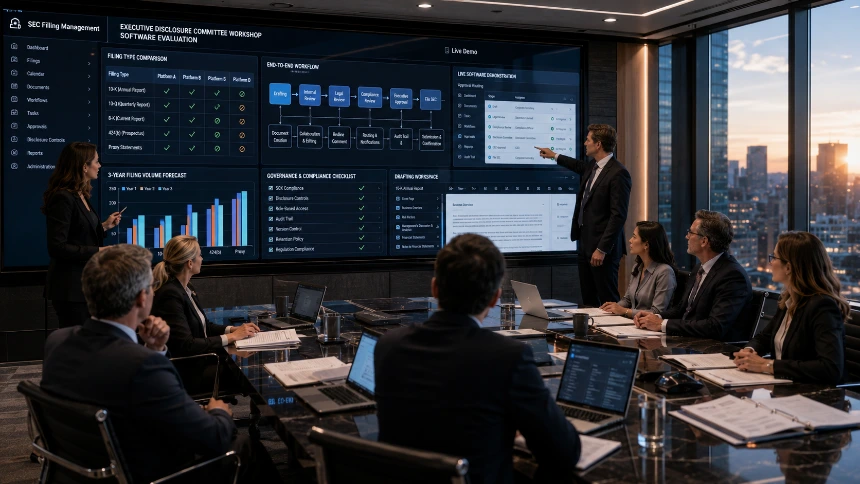
Most disclosure committees should evaluate SEC filing tools using real filing workflows rather than simplified demonstrations or isolated feature walkthroughs.
A practical vendor evaluation process typically includes:
- Defining the next three years of expected filing volume by form type, including 10-Ks, 10-Qs, 8-Ks, 424(b)s, proxy filings, and registered-funds workflows.
- Scoring each shortlisted vendor against filing coverage, workflow controls, AI capabilities, governance requirements, support model, and total cost.
- Running a live demo on a real filing rather than a sandbox environment.
- Piloting the AI-assisted layer on a single filing before broader deployment.
- Confirming data-handling, retention, and external-model training policies in writing.
- Requiring customer references within the same filing segment, since capital markets and registered-funds workflows often operate differently.
Live workflow testing is usually more valuable than controlled demos because it exposes how systems behave during actual drafting, review, and filing cycles.
Frequently Asked Questions
What is the best SEC filing software for a 10-K or 10-Q?
The best SEC filing software for a 10-K or 10-Q depends on how your team manages drafting, review, iXBRL tagging, and EDGAR submission. Large public companies often use platforms such as Workiva, DFIN ActiveDisclosure, or Toppan Merrill Bridge as the system of record, then add AI-assisted review tools to accelerate drafting and disclosure comparison workflows. For recurring reporting cycles, workflow fit matters more than feature count alone.
How does AI-assisted SEC filing software differ from a traditional filing agent?
Traditional filing agents focus on EDGAR submission, iXBRL tagging, validation checks, and filing logistics. AI-assisted SEC filing software operates earlier in the workflow by accelerating drafting, precedent review, and disclosure comparison before submission begins. Most public companies now combine both layers inside the same reporting process.
What is the difference between precedent-based AI and generative AI for SEC filings?
Generative AI creates new text using statistical prediction patterns, which can introduce hallucination risk and reduce source traceability. Precedent-based AI extracts and structures verbatim language directly from public EDGAR filings with traceable citations. That makes outputs auditable and verifiable throughout disclosure review workflows. In high-stakes SEC reporting environments, many teams prefer precedent-based workflows with traceable sources because unsupported disclosure language creates legal and operational risk.
Does AI-assisted filing software replace EDGAR submission?
No. AI-assisted filing software does not replace EDGAR infrastructure or filing agents. It operates upstream in the workflow by helping legal, finance, and disclosure teams accelerate drafting and review before submission. EDGAR validation, taxonomy checks, iXBRL tagging, and filing transmission still require dedicated filing workflows and controls.
How much does SEC filing software typically cost?
Enterprise SEC reporting platforms are usually custom-quoted, but publicly reported market ranges commonly fall between roughly $2,000 and $25,000 per month depending on workflow scope and filing complexity. Filing-agent services may also add roughly $500 to $5,000 per disclosure. Buyers should also evaluate professional services, XBRL support, training, and AI add-on pricing when assessing total cost of ownership.
Is client data used to train external AI models?
That depends on the vendor's data-governance policies. Buyers should confirm whether client documents are retained, whether prompts are stored, and whether company data is used to train external models. Dimension AI maintains zero data retention policies, and we never train external AI models on your data.
Closing Thoughts
Choosing the best SEC filing software is ultimately about reducing risk, maintaining auditability, and supporting the way disclosure teams already operate. Most public companies will continue to rely on enterprise reporting platforms and EDGAR filing infrastructure as the system of record, while adding AI-assisted drafting and review layers to compress review cycles and improve consistency across filings.
For capital markets teams, registered funds, and recurring SEC reporting workflows, precedent-based review workflows can reduce manual drafting and disclosure comparison work without sacrificing governance or traceability.
See how a precedent-based review layer compares against your current filing workflow — every output cited, every change auditable, no client data used to train external models. Request access.
To access this endpoint, you must have an approved developer account, and have activated the new developer portal. When authenticating, you must use keys and tokens from a developer App that is located within a Project. Learn more about getting access to the API v2 endpoints in our "Getting started" page:
Once you have the API v2 collection loaded in Postman
The hide replies endpoint uses OAuth 1.0a user context authentication. If successful, the endpoint hides a single Reply that was published in a Tweet conversation that was initiated by an authenticated user. Each conversation supports hiding up to 725
This endpoint gives you the ability to programmatically hide or unhide replies using criteria you define. Just like the functionality in the main
There are several different tools and libraries that you can use to make a request to this endpoint, but we are going to use the Postman tool here to simplify the process.