Best Disclosure Management Software for SEC Reporting Teams
Disclosure management is the operational backbone of public-company reporting. It is the system that turns scattered financial data, narrative drafts, footnotes, certifications, and XBRL tagging into filed disclosures ready for EDGAR, ESEF, SEDAR, and other regulatory destinations. The best disclosure management software sits within the broader governance, risk, and compliance stack and overlaps with corporate performance management and SEC filing workflows. For SEC reporting teams managing 10-Ks, 10-Qs, 8-Ks, DEF 14A filings, and 424(b) transactions, the process is no longer just about document production. It is about collaboration, auditability, workflow control, and reducing review cycles without increasing risk.
The best disclosure management software depends on the filing mix, the complexity of the reporting process, which team owns the workflow, and how much drafting and review can be compressed through automation and AI. Some disclosure management solutions focus heavily on financial reporting and XBRL workflows. Others extend into ESG, statutory reporting, and narrative collaboration. A newer category — AI-assisted drafting and review — now sits alongside enterprise disclosure management systems to compress drafting and review hours while preserving auditability. This guide covers what disclosure management software is, what SEC reporting teams actually need, how leading disclosure management solutions software platforms compare, where AI-assisted drafting and review fits, security and compliance considerations, pricing structure, and how to evaluate vendors before making a decision.
What Is Disclosure Management Software?
Disclosure management software is the workflow layer that automates the creation, review, tagging, approval, and submission of regulatory financial and non-financial disclosures. It sits between source-of-truth financial systems such as ERP, consolidation, and CPM/EPM platforms and filing destinations such as EDGAR, ESEF, SEDAR, and other statutory regulators. The goal is to centralize collaboration, preserve audit trails, maintain linked-data consistency, and reduce manual formatting and tagging work across the reporting process.
Most disclosure management systems support structured financial reporting workflows, including workflow management, version control, audit trails, XBRL and iXBRL tagging, certifications, reviewer workflows, role-based approvals, and submission preparation. Teams typically use disclosure management software to coordinate work across finance, legal, compliance, investor relations, external auditors, and filing agents. Many financial disclosure management software platforms also integrate directly with Excel and Word to support linked reporting workflows and reduce manual updates across filings.
The category covers both financial disclosures and narrative reporting. Financial disclosure workflows include filings such as 10-Ks, 10-Qs, 20-Fs, 40-Fs, 6-Ks, N-CSR filings, statutory accounts, and ESEF reporting. Narrative workflows may include MD&A drafting, ESG reporting, sustainability reports, board books, governance documentation, and disclosure committee materials. Some disclosure management solutions focus primarily on structured financial reporting workflows, while others support broader enterprise reporting and governance processes across multiple business functions.
Disclosure management software also overlaps with SEC filing services, but the two are distinct. Filing agents submit disclosures to regulators. Disclosure management platforms produce, manage, review, and control the disclosures themselves.
What SEC Reporting Teams Actually Need?
SEC reporting is a multi-contributor process. Finance teams prioritize data integrity, linked reporting, and reconciliation accuracy. Legal teams focus on disclosure language, change tracking, and disclosure committee workflows. Compliance teams prioritize control evidence, certifications, and audit trails. The reporting platform has to support all three stakeholder groups without creating workflow fragmentation.
The most effective disclosure management systems support the following core requirements:
- Multi-contributor collaboration — Finance, legal, compliance, investor relations, external auditors, and filing agents often work inside the same disclosure simultaneously, particularly during 10-K and 10-Q reporting cycles.
- Strong version control and audit trails — Every change should be attributable to a specific user, every prior version should remain recoverable, and all review activity should be preserved throughout the reporting cycle.
- Integrated iXBRL tagging — SEC disclosure reporting software should support current taxonomies, automated tagging where appropriate, and expert review workflows where manual validation is required.
- Excel and Word integration — Most SEC reporting teams already operate inside Microsoft Office environments. Financial disclosure management software should integrate directly with Excel and Word rather than forcing teams into disconnected workflows.
- Linked data management — A single number may appear across multiple sections of a filing. The best disclosure management software for finance maintains one source of truth, with updates propagated automatically across disclosures, footnotes, and supporting schedules.
- Workflow routing and certifications — Teams need role-based approvals, sub-certifications, disclosure committee sign-offs, reviewer comments, section locking, and controlled approval workflows.
- Output flexibility — Disclosure management solutions should support Word, PDF, HTML, EDGAR HTML, XBRL, and iXBRL outputs across different filing and reporting requirements.
- AI-assisted drafting and review — Modern sec disclosure management software increasingly includes precedent-based drafting support, change detection against prior filings, citation to source disclosures, controlled reviewer approvals, and traceable audit logs.
Enterprise disclosure management systems still function as the system of record. AI-assisted drafting and review functions as an additional workflow layer that helps compress drafting, precedent analysis, and review time.
There is also an important distinction between generative AI and precedent-based workflows. Generative AI produces new text probabilistically, which introduces hallucination risk and can make outputs difficult to audit back to source material. Precedent-based workflows extract and structure language from defined sets of public filings, keeping outputs traceable to source disclosures. In SEC reporting, where the hallucination-tolerance budget is effectively zero, auditability and traceability matter more than novelty.
Buyer Evaluation Criteria
Choosing a disclosure management platform is usually a multi-year operational decision. Disclosure committees and controllership teams should score platforms against the next three years of expected filing volume, reporting complexity, and form mix rather than focusing only on current-quarter requirements.
Filing Coverage and Workflow Fit
Different organizations operate under different reporting obligations. A domestic SEC filer managing 10-Ks and 8-Ks has different requirements than a foreign private issuer handling 20-F and 6-K workflows or a registered fund managing N-1A and N-CSR filings.
Teams should evaluate support for:
- 10-K, 10-Q, and 8-K filings
- S-1, S-3, and 424(b) offerings
- DEF 14A proxy workflows
- 20-F, 40-F, and 6-K reporting
- N-1A and N-CSR filings
- ESEF, SEDAR, and statutory reporting
The best disclosure management software for finance teams is not always the best fit for multinational or legal-heavy reporting environments. Filing mix matters more than broad feature counts.
Collaboration, Data Integration, and Workflow Automation
Workflow collaboration is where many disclosure management solutions software platforms either improve operational control or create reporting friction.
Buyers should evaluate:
- Co-authoring, comments, role-based routing, change tracking, and certifications
- ERP, consolidation, EPM/CPM, and Excel integrations
- Live links and roll-forward workflows
- Templates, snippets, push-down updates, and intelligent text updates
- Linked-data consistency across disclosures and supporting schedules
Integration depth matters because reporting teams often operate across fragmented systems with multiple data owners and reporting contributors.
Tagging and Output Control
Disclosure reporting software should support accurate XBRL and iXBRL workflows with current taxonomy management, validation checks, and reviewer oversight.
Teams should evaluate:
- XBRL and iXBRL tagging accuracy
- Taxonomy updates and validation workflows
- Output support for Word, PDF, HTML, EDGAR HTML, XBRL, and iXBRL
AI Capabilities, Security, and Data Governance
Security and governance requirements are higher in SEC reporting environments than in general collaboration software.
At minimum, buyers should evaluate:
- Precedent-based versus generative AI workflows
- Hallucination risk, source citation, and auditability
- SOC 1 and SOC 2 attestations
- Encryption in transit and at rest
- Audit log retention and export
- AI training-data policies and data retention controls
AI governance deserves separate scrutiny. Reporting teams should ask whether client data is used to train external AI models, whether outputs remain traceable to source documents, and where information is hosted.
Dimension AI uses precedent-based workflows with traceable sources, zero hallucination risk, and auditable and verifiable outputs where every output can be audited back to its source. The platform also supports zero data retention policies and never trains external AI models on client data.
Support, Deployment, and Pricing
Teams should also evaluate:
- XBRL consultants, training, and certification programs
- Vendor response times and implementation support
- Cloud, hybrid, and on-prem deployment options
- Subscription, per-seat, per-filing, and services-based pricing models
The top disclosure management software platforms often differ more in workflow specialization, governance controls, and implementation model than in headline feature lists alone.
Comparison: Leading Disclosure Management Platforms
The disclosure management category includes enterprise reporting suites, statutory reporting systems, XBRL-focused platforms, and AI-assisted drafting and review layers. The best disclosure management software depends on filing complexity, governance requirements, reporting ownership, and workflow structure.
| Platform | Primary Focus | Notable Differentiators |
|---|---|---|
| Workiva | SEC, SOX, ESG, and governance reporting | Frequently appears as a G2 Leader; public materials cite a Forrester-reported 204% ROI figure; widely characterized as one of the most expensive platforms in the category with one of the largest market footprints |
| DFIN ActiveDisclosure | SEC reporting and linked-data workflows | Excel-linked single-source-of-truth reporting, Active Intelligence AI suite, ActiveDisclosure Certifications for SEC and SOX workflows, and #1 filing agent positioning |
| Certent Disclosure Management (InsightSoftware) | Microsoft Office-integrated disclosure management | "All-in-one system built on Microsoft Office"; supports 200+ data sources and 140+ ERP/EPM integrations; supports US GAAP, IFRS, and ESEF taxonomies |
| Toppan Merrill Bridge | Integrated disclosure and filing workflows | Single integrated SaaS platform with Word-, Excel-, and PowerPoint-familiar workflows; dedicated iXBRL consultants; 55+ years of disclosure experience; 3M+ XBRL tags annually |
| Anaplan Disclosure Management | Cloud-native finance reporting workflows | Automated roll-forward workflows, push-down updates, intelligent text updates, and out-of-the-box templates; public materials state go-live in as little as two weeks |
| CCH Tagetik | CPM-integrated disclosure management | Disclosure management positioned inside a broader CPM stack |
| Lucanet | Financial consolidation and statutory reporting | Focuses on consolidation, statutory reporting, and finance-governance workflows |
| Oracle Hyperion Disclosure Management | Enterprise disclosure reporting | Long-running incumbent enterprise platform with established installed base |
| SAP Document and Reporting Compliance | Global statutory and indirect-tax reporting | Focuses on multinational statutory and tax-reporting workflows |
| Thomson Reuters disclosure management | Global statutory reporting | Country-specific statutory reporting templates and regulatory content updates |
| IRIS CARBON | XBRL-focused disclosure reporting | XBRL-led SEC and regulatory reporting workflows |
| DataTracks Rainbow | XBRL-focused compliance reporting | XBRL-led disclosure and compliance workflows |
| Dimension AI | AI-assisted drafting and review | Precedent-based workflows with traceable sources, verbatim extraction from EDGAR, fully cited outputs, zero hallucination risk, auditable and verifiable workflows, Azure Private Cloud and Azure Public Cloud deployment, zero data retention, and no training on client data |
Dimension AI publicly reports workflow savings of 10+ hours per 424(b) transaction and 15+ hours saved per annual report workflow.
G2 category data across more than 52 products and 3,200+ reviews reports average ease-of-use scores around 8.8/10 and average support-quality scores around 8.7/10. Common buyer complaints across disclosure management solutions software platforms include learning-curve issues, complex setup requirements, and slow performance under large document workloads.
Before selecting a platform, reporting teams should pilot:
- Live 10-K or 10-Q reporting workflows
- Disclosure committee routing and approval workflows
- Linked-data and tie-out processes
- XBRL validation workflows
- AI-assisted drafting against internal precedent sets
The most useful evaluation environments are real reporting cycles rather than controlled sandbox demonstrations.
Collaboration and Control Features That Matter Most
Many disclosure management software adoption problems appear only after the first live filing cycle. Reporting teams should evaluate collaboration and control workflows using real 10-K, 10-Q, or proxy documents because this is where operational bottlenecks and reviewer friction typically emerge.
High-value capabilities in disclosure management systems include:
- Real-time co-authoring with role-based permissions
- Track changes with attribution and clean or markup views
- Comment threads tied to specific document positions
- Section locking and sub-certifications
- Disclosure committee workflow and sign-off routing
- Tie-out binders with auto-generated tables of contents and linked support documents
- Snippets and content presets that support edit-once, update-everywhere workflows
- Push-down updates and intelligent text updates that propagate a single source-of-truth number across the filing
Tie-out workflows matter because support documentation often becomes fragmented during large reporting cycles. Financial disclosure management software that preserves linked support documents and organized tie-out structures reduces manual reconciliation work and improves review control.
This is also the area where reporting teams should pilot workflows instead of relying on product demonstrations alone. Most workflow pain appears only after a real document, real contributors, and real review cycles are introduced into the process.
Automating Manual Process: Where Real Hour Savings Come From
The largest workflow savings in disclosure reporting software come from reducing repetitive drafting, tagging, reconciliation, and review work. Enterprise disclosure management systems compress data-management and tagging workflows, while AI-assisted drafting and review layers compress the actual writing and reading process. Used together, the two layers produce the largest operational time savings.
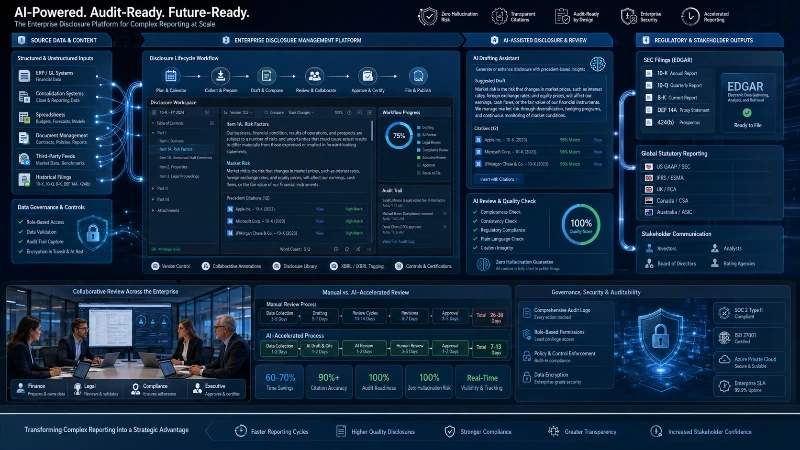
The highest-leverage automation areas in financial disclosure management software include:
- Roll-forward and prior-period carryforward workflows — Reuse prior reporting structures, disclosures, and linked content across recurring filing cycles.
- Automated iXBRL tagging with reviewer correction — Reduce manual tagging work while preserving reviewer validation and taxonomy oversight.
- Linked Excel-to-document data propagation — Maintain a single source of truth across MD&A sections, footnotes, certifications, and supporting schedules.
- AI-assisted drafting against precedent filings — Surface prior disclosure language, flag inconsistencies, and cite source disclosures during drafting and review workflows.
Vendor-reported metrics illustrate where operational savings typically appear. Certent customer materials cite an average 40% reduction in annual report production time. Anaplan states that certain deployments can go live in as little as two weeks. Dimension AI reports 10+ hours saved per 424(b) transaction and 15+ hours per annual report workflow through precedent-based drafting and review workflows.
AI-Assisted Drafting and Review: Precedent-Based vs Generative
AI adoption across sec disclosure management software environments is increasing, but governance expectations remain high because SEC filings are legal and regulatory documents.
Generative AI systems produce new probabilistic text outputs. That introduces hallucination risk, unclear sourcing, and inconsistent traceability. Precedent-based AI operates differently. It extracts and structures verbatim language from public EDGAR filings, with outputs cited back to source disclosures. There is no generation step.
For SEC reporting teams, the distinction matters because SEC filings are legal documents, and the hallucination-tolerance budget is effectively zero. Every output should be auditable and verifiable, and every output should be traceable back to source filings.
AI-assisted drafting and review sits on top of disclosure management platforms rather than replacing them. The enterprise suite remains the system of record and the submission path. Dimension AI uses precedent-based workflows with traceable sources, zero hallucination risk, and auditable and verifiable outputs where every output can be audited back to its source. Dimension AI never trains external AI models on client data.
For teams evaluating the best disclosure management software or top disclosure management software platforms, the distinction is operational as much as technical. Enterprise disclosure management systems coordinate reporting workflows, while AI-assisted drafting and review compresses the actual writing and review process while preserving governance controls.
Security, Audit Trails, and Compliance
Security reviews are now standard parts of disclosure management software evaluations, particularly for SEC reporting teams handling regulated financial disclosures.
Reporting teams should request detailed answers around:
- SOC 1 and SOC 2 attestations and audit scope
- Encryption in transit and at rest
- Role-based access controls with SSO and MFA support
- Audit log retention and export capabilities
- Data residency and hosting environments
- AI training-data policies
- Data retention policies
Audit trails are not only operational controls. They also function as control evidence and as a defense during SEC inquiries, reviews, and litigation. Every document change should remain attributable, and every output should remain citable back to source documents.
For AI-assisted workflows, buyers should ask whether client data is used to train external AI models, what the retention policy is, and where data is hosted. Dimension AI never trains external AI models on client data, maintains zero data retention policies, and supports both Azure Private Cloud and Azure Public Cloud deployment environments.
These governance requirements are increasingly important as AI-assisted capabilities expand across financial disclosure management software and disclosure reporting workflows.
Deployment, Pricing, and Total Cost of Ownership
Cloud and SaaS deployment models now dominate the disclosure management software market, although some legacy on-premise and hybrid deployments remain.
Key market considerations include:
- Deployment — Cloud and SaaS models are now standard across most top disclosure management software platforms.
- Enterprise pricing — Publicly reported market pricing generally ranges from roughly $2,000 to $25,000 per month depending on filing complexity, workflow scope, and user count.
- Filing-agent services — Per-document pricing typically ranges from roughly $500 to $5,000 per disclosure depending on filing type and complexity.
- Professional services — XBRL tagging, template setup, training, and EDGAR submission support are often sold separately.
- AI add-on pricing — AI-assisted drafting and review is typically priced through usage-based or per-seat licensing models.
Customers consistently report Workiva as one of the most expensive platforms in the category, particularly for enterprise deployments.
For teams evaluating the best disclosure management software for finance, the most useful comparison is total cost of ownership rather than headline subscription pricing alone. Buyers should assess combined software, services, AI add-on, and training costs across the full reporting workflow.
How to Run a Vendor Evaluation?
The most effective disclosure management software evaluations are tied to real reporting workflows rather than controlled product demonstrations.
Reporting teams should:
- Map expected filing volume by form type across the next three years
- Identify stakeholder groups involved in drafting, review, approvals, and certifications
- Document collaboration dependencies across finance, legal, compliance, IR, and external auditors
- Score each shortlisted vendor against workflow, tagging, security, AI, and governance requirements
- Pilot live 10-K, 10-Q, 8-K, 20-F, N-CSR, or 424(b) workflows instead of sandbox demos
- Pilot AI-assisted drafting and review separately against internal precedent sets
- Confirm data-handling, retention, and training-data policies in writing
- Request references from organizations with similar filing obligations, including public-company SEC filers, registered funds, and foreign private issuers
Evaluation criteria should reflect operational priorities and filing complexity. A registered fund managing N-CSR and N-1A workflows may prioritize different capabilities than a foreign private issuer handling 20-F reporting or a domestic SEC filer focused heavily on 424(b) transactions.
Sandbox demos rarely expose workflow bottlenecks around linked data, reviewer coordination, disclosure committee approvals, or tie-out processes. For teams comparing the best disclosure management software or top disclosure management software platforms, the most useful evaluation environment is a real reporting cycle.
Frequently Asked Questions
What is disclosure management software?
Disclosure management software helps public companies create, review, tag, and prepare regulatory disclosures for submission. It connects source systems such as ERP, consolidation, and CPM/EPM platforms to filing destinations including EDGAR, ESEF, and SEDAR. Most disclosure management systems also include collaboration workflows, audit trails, version control, and XBRL or iXBRL tagging.
How is disclosure management software different from SEC filing software?
Disclosure management software focuses on drafting, review, approvals, linked data, and tagging workflows. SEC filing software focuses more heavily on formatting and EDGAR submission. Many enterprise platforms overlap across both categories, but filing agents submit filings while disclosure management platforms manage and produce them.
What features matter most for an SEC reporting team?
The most important capabilities are usually collaboration controls, auditability, linked data, and workflow automation. Reporting teams should also evaluate Excel and Word integration, iXBRL workflows, role-based routing, and whether AI-assisted outputs remain traceable back to source filings.
How does AI fit into a disclosure management workflow?
AI-assisted drafting and review sits on top of the disclosure management platform rather than replacing it. Enterprise suites manage workflow coordination, linked data, and filing preparation, while precedent-based AI accelerates drafting and review workflows using cited language from prior filings. Dimension AI reports workflow savings of 10+ hours per 424(b) transaction and 15+ hours per annual report through precedent-based workflows with traceable sources.
How much does disclosure management software cost?
Enterprise disclosure management software is typically sold as a SaaS subscription, with publicly reported market pricing ranging from roughly $2,000 to $25,000 per month depending on workflow scope and filing complexity. Filing-agent services may add another $500 to $5,000 per disclosure. Buyers should evaluate total cost of ownership across software, implementation, training, and AI add-ons.
Can disclosure management software handle both financial and narrative reporting?
Yes. Most financial disclosure software supports both structured financial reporting and narrative disclosure workflows, including 10-Ks, 20-Fs, 8-Ks, MD&A, ESG disclosures, sustainability reporting, and board materials. Some platforms focus more heavily on XBRL and financial reporting, while others support broader governance and reporting workflows.
Choosing the Right Disclosure Management Workflow

The best disclosure management software is the platform that fits your filing complexity, collaboration model, and control requirements across multiple reporting cycles — not just the next quarter. For SEC reporting teams handling 10-Ks, 10-Qs, 8-Ks, registered-fund workflows, or global statutory reporting, the priority is consistent execution, auditability, and fewer manual review hours.
Enterprise disclosure management platforms remain the system of record for reporting operations. Precedent-based AI layers can sit alongside those systems to compress drafting and review workflows while keeping outputs auditable and verifiable back to source filings.
See how a precedent-based AI layer can sit alongside your disclosure management platform — every output cited, every change auditable, no client data used to train external models. Request access.
To access this endpoint, you must have an approved developer account, and have activated the new developer portal. When authenticating, you must use keys and tokens from a developer App that is located within a Project. Learn more about getting access to the API v2 endpoints in our "Getting started" page:
Once you have the API v2 collection loaded in Postman
The hide replies endpoint uses OAuth 1.0a user context authentication. If successful, the endpoint hides a single Reply that was published in a Tweet conversation that was initiated by an authenticated user. Each conversation supports hiding up to 725
This endpoint gives you the ability to programmatically hide or unhide replies using criteria you define. Just like the functionality in the main
There are several different tools and libraries that you can use to make a request to this endpoint, but we are going to use the Postman tool here to simplify the process.