Introduction
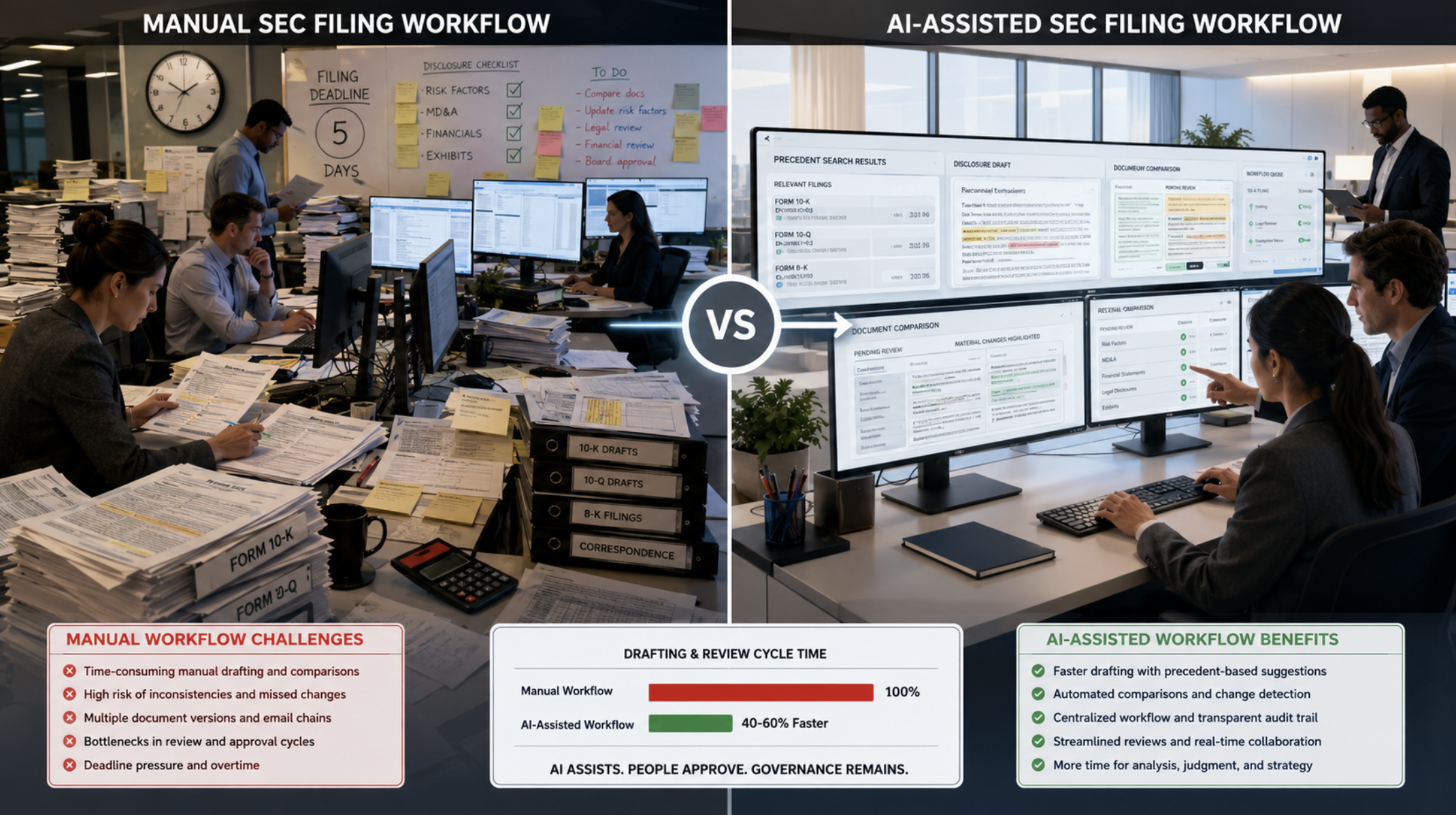
Manual SEC filing workflows rely on human drafting, prior-filing searches, and sequential review cycles that compress under deadline pressure. AI-assisted workflows apply precedent-based extraction and structured review to reduce drafting and revision time — without replacing human judgment or EDGAR submission infrastructure. The difference is not whether humans review; it is how much time they spend on low-value drafting tasks vs. high-judgment review decisions. For 10-K, 10-Q, 8-K, and 424(b) workflows, the time savings are measurable and the governance requirements remain intact.
Public company legal, finance, and compliance teams rarely struggle with understanding SEC disclosure requirements. The challenge is executing recurring SEC filing workflows that involve precedent research, multiple review cycles, document reconciliation, and fixed filing deadlines. As reporting obligations grow more complex, many organizations are evaluating whether legal workflow automation can improve efficiency while maintaining governance, auditability, and human oversight throughout 10-K and 10-Q reporting cycles.
This article compares manual and AI-assisted SEC filing workflows from an operational perspective rather than a software or vendor comparison. It examines where manual processes create bottlenecks, how disclosure management and disclosure workflow automation can reduce repetitive drafting and review tasks, and where legal judgment, disclosure committee oversight, and regulatory accountability remain essential.
What Does a Manual SEC Filing Workflow Actually Look Like?
A manual SEC filing workflow involves coordinated work across legal, finance, accounting, investor relations, external counsel, auditors, and filing agents. During recurring 10-K and 10-Q reporting cycles, most effort goes toward updating existing disclosures, validating financial data, managing reviews, and maintaining consistency across the filing rather than drafting from scratch.
A typical manual workflow includes the following steps:
- Search prior filings for precedent. Teams review historical filings in EDGAR to locate disclosure language for sections such as risk factors, Management's Discussion and Analysis (MD&A), business updates, and footnotes. Relevant precedent is identified before drafting begins.
- Update disclosures manually. Drafts are typically prepared in Microsoft Word by copying and revising language from prior filings. Financial figures, material developments, accounting changes, and regulatory updates must all be reviewed and incorporated accurately.
- Manage sequential review cycles. Drafts move through finance, legal, disclosure committee, and executive reviews. Each round generates comments, revisions, and additional document versions that must be reconciled before approval.
- Coordinate supporting documentation. Teams collect required exhibits, work with outside counsel on legal disclosures, coordinate with external auditors on financial information, and confirm that supporting materials are complete before filing.
- Validate financial consistency. Financial statements, tables, narrative disclosures, and footnotes must reconcile across the document. Even a single updated figure can require revisions in multiple sections, increasing the risk of manual errors.
- Prepare for EDGAR submission. After review, the filing undergoes XBRL or iXBRL tagging, EDGAR validation, and final submission through the company's filing agent or reporting platform.
Each step is necessary to satisfy SEC disclosure requirements, but the process relies heavily on manual precedent searches, repetitive drafting, version reconciliation, and cross-functional coordination. Understanding where time is spent provides the foundation for evaluating how AI-assisted workflows can streamline repetitive tasks while preserving legal judgment, disclosure committee oversight, and regulatory governance.
Where AI-Assisted Tools Fit in the Workflow
Understanding the manual process makes it easier to identify where AI-assisted tools improve the SEC filing workflow and where they should not replace human decision-making. In an AI SEC reporting workflow, the greatest efficiencies come from reducing repetitive precedent searches, drafting, and document review while leaving materiality assessments, governance, and regulatory accountability with the legal and compliance professionals responsible for the filing.
For recurring 10-K, 10-Q, 8-K, and other precedent-driven filings, AI is most effective at supporting upstream work, including:
- Extracting and organizing precedent language from public EDGAR filings.
- Structuring initial drafts from verified prior disclosures instead of starting from a blank document.
- Comparing current drafts against prior filings to identify material changes, inconsistencies, and omissions.
- Accelerating review cycles by reducing manual document comparison and version reconciliation across legal, finance, and compliance teams.
These capabilities strengthen SEC filing automation and disclosure workflow automation by reducing manual search time and improving review efficiency without changing established approval processes.
However, AI does not replace the functions that require professional judgment. Legal counsel determines materiality and regulatory interpretation, disclosure committees retain approval authority, independent auditors perform their required review procedures, and filing agents remain responsible for EDGAR validation, XBRL/iXBRL tagging, and final submission.
For SEC reporting, the distinction between precedent-based AI and generic generative AI is particularly important. Precedent-based systems generate outputs from verified public filings, allowing reviewers to trace proposed language back to its source and maintain an auditable review process. By contrast, unsupported AI-generated text introduces unnecessary compliance risk because hallucinated content cannot be verified against authoritative SEC disclosures.
The objective of legal workflow automation is not to replace professional judgment. It is to reduce repetitive drafting and manual review so legal, finance, and compliance teams can focus on higher-value decisions, strengthen disclosure management, and meet SEC reporting deadlines with greater accuracy and consistency.
Precedent-Based AI vs. Generative AI — Why It Matters for SEC Filings
Not all AI supports SEC filing workflows in the same way. For public company reporting, the most important distinction is whether AI works from verified filing precedent or generates new text from language patterns. That difference affects the reliability, auditability, and defensibility of every proposed disclosure.
Precedent-based AI supports regulated drafting by working from existing public EDGAR filings. Instead of creating new disclosure language, it identifies relevant precedent, organizes comparable disclosures, and presents source-backed recommendations for review. Reviewers can verify the originating filing, compare it against current disclosures, and decide whether to accept or reject each proposed change. This approach aligns with established disclosure management practices because every recommendation remains traceable throughout the review process. For a more detailed evaluation, see our SEC filing software comparison.
By contrast, generative AI predicts text based on patterns learned during training rather than verified SEC disclosures. While it can accelerate general writing tasks, it may also produce unsupported or inaccurate language. In SEC reporting, where disclosures must withstand legal, regulatory, and auditor review, content without verifiable precedent introduces unnecessary compliance risk.
When evaluating legal workflow automation, legal and compliance teams should prioritize workflows that provide:
- Source-backed recommendations from verified SEC filings.
- Transparent review with accept-or-reject decisions.
- Complete auditability from proposed language to final disclosure.
The objective is not simply faster drafting. It is to reduce repetitive work while preserving the governance, professional judgment, and documentation required for accurate, defensible SEC reporting.
Time Savings by Filing Type
The value of legal workflow automation is easiest to measure in recurring SEC reporting workflows where teams repeatedly search for precedent, update disclosures, and complete multiple review cycles. According to published figures from the Dimension AI platform, the largest time savings occur before final legal review by reducing manual precedent searches, repetitive drafting, and document comparisons.
| Filing Type | Published Time Savings | Primary Workflow Impact |
|---|---|---|
| Form 424(b) | 10+ hours saved per transaction | Reduces manual precedent retrieval, drafting, and review during compressed capital markets timelines. |
| Form 10-K | 15+ hours saved per filing cycle | Reduces repetitive drafting and comparison work across multi-team annual reporting cycles. |
These efficiencies become more meaningful across recurring filing obligations. A public company completing three capital markets transactions per quarter while preparing two annual report cycles each year repeats many of the same drafting, comparison, and review activities. Reducing those upstream tasks allows legal, finance, and compliance teams to spend more time evaluating disclosures and less time recreating prior work.
For organizations evaluating disclosure management, these published figures provide a practical benchmark for assessing workflow improvements. See the Dimension AI platform to understand how precedent-based workflows support faster drafting and review while preserving existing governance, approval, and audit processes.
What Skeptics Need to Know — Governance and Auditability
For legal, finance, and compliance teams, adopting AI is less about drafting speed than governance. The key question is whether an AI SEC reporting workflow can withstand review by the disclosure committee, external auditors, and other stakeholders responsible for SEC compliance. That depends on whether every recommendation is transparent, verifiable, and subject to human oversight.
An auditable SEC filing workflow should include the following controls:
- Source traceability: Every suggested disclosure should map back to a specific public SEC filing, allowing reviewers to verify the underlying precedent before accepting a recommendation.
- Human-controlled review: AI should support an accept-or-reject workflow. Decisions involving materiality, disclosure language, and final approval remain the responsibility of legal, finance, and compliance teams.
- Data governance: Organizations should confirm that client documents are subject to zero data retention and are not used to train external AI models, helping protect confidential information.
- Enterprise security: Controls such as SOC 2 Type II certification and deployment through Microsoft Azure Private Cloud provide a strong security baseline for regulated disclosure workflows.
These governance controls distinguish precedent-based legal workflow automation from generic AI content generation. A workflow that preserves source traceability, maintains auditability, and keeps reviewers in control is easier to defend during disclosure committee reviews and external audits. Learn more about security and data governance and the controls that support compliant disclosure management workflows.
When Manual Still Makes Sense
Legal workflow automation is not the right fit for every public company. Very small reporting companies with straightforward disclosure obligations, infrequent SEC filings, and lean legal or finance teams may find that a manual SEC filing workflow remains practical. When filings require limited precedent research, involve few reviewers, and follow a predictable review process, the operational benefits of a dedicated AI layer may not justify the investment.
As reporting complexity increases, however, the equation changes. Organizations managing recurring Forms 10-K, 10-Q, and 8-K, or frequent capital markets transactions, typically spend more time searching for precedent, coordinating reviews, and reconciling document versions. In those situations, disclosure management and legal workflow automation can reduce repetitive work while preserving established governance, approval, and audit processes.
The right approach depends on reporting complexity, filing volume, and internal workflow requirements, not on adopting AI for its own sake.
Frequently Asked Questions
Can AI tools replace a filing agent for SEC submissions?
No. AI-assisted tools support the SEC filing workflow by accelerating precedent search, drafting, and document review. Filing agents remain responsible for EDGAR validation, iXBRL tagging, and final SEC submission. AI supports drafting and review but does not replace filing infrastructure or regulatory submission requirements.
Is AI-assisted SEC filing reliable enough for a disclosure committee?
It depends on the workflow. A precedent-based AI SEC reporting workflow with source traceability, accept-or-reject review, and audit logs provides an auditable process for legal and finance teams. By contrast, generative AI that cannot cite the source of its recommendations is more difficult to validate and introduces additional governance risk.
What is the difference between AI drafting and AI review for SEC filings?
AI drafting uses precedent from prior public filings to prepare an initial disclosure for review. AI review compares current disclosures with prior filings, identifies inconsistencies, and highlights changes that require further review. Both support different stages of the workflow, while legal and compliance teams remain responsible for materiality assessments and final approval.
How do legal teams ensure AI outputs are auditable for SEC purposes?
Every output should be traceable to a source filing. Legal teams should look for workflows that provide source citations, maintain audit logs, support accept-or-reject review, and follow strong data governance practices, including zero data retention and no external model training on client documents.
Does AI-assisted review require specialized SEC compliance knowledge?
Yes. The expertise belongs to the reviewer, not the software. AI reduces the time spent searching precedent and reviewing disclosures, but legal, finance, and compliance professionals remain responsible for materiality assessments, regulatory interpretation, and filing decisions.
What SEC filing types benefit most from AI-assisted workflows?
The greatest benefits typically occur in filings with high precedent density or compressed reporting timelines. Form 424(b) transactions can save 10+ hours per transaction, while Form 10-K workflows can save 15+ hours per filing cycle, based on Dimension AI's published figures. Forms S-1, S-3, and 10-Q also benefit because they involve recurring disclosures, significant precedent analysis, and multi-stage review workflows.
See How Dimension AI Compares Against Your Current SEC Filing Workflow
Choosing the right legal workflow automation approach starts with understanding where your current SEC filing workflow spends the most time. See how the Dimension AI platform helps legal, finance, and compliance teams streamline drafting and review while keeping every output cited, every change auditable, and every decision under human control.
See how Dimension AI compares against your current SEC filing workflow. Every output cited, every change auditable.
To access this endpoint, you must have an approved developer account, and have activated the new developer portal. When authenticating, you must use keys and tokens from a developer App that is located within a Project. Learn more about getting access to the API v2 endpoints in our "Getting started" page:
Once you have the API v2 collection loaded in Postman
The hide replies endpoint uses OAuth 1.0a user context authentication. If successful, the endpoint hides a single Reply that was published in a Tweet conversation that was initiated by an authenticated user. Each conversation supports hiding up to 725
This endpoint gives you the ability to programmatically hide or unhide replies using criteria you define. Just like the functionality in the main
There are several different tools and libraries that you can use to make a request to this endpoint, but we are going to use the Postman tool here to simplify the process.