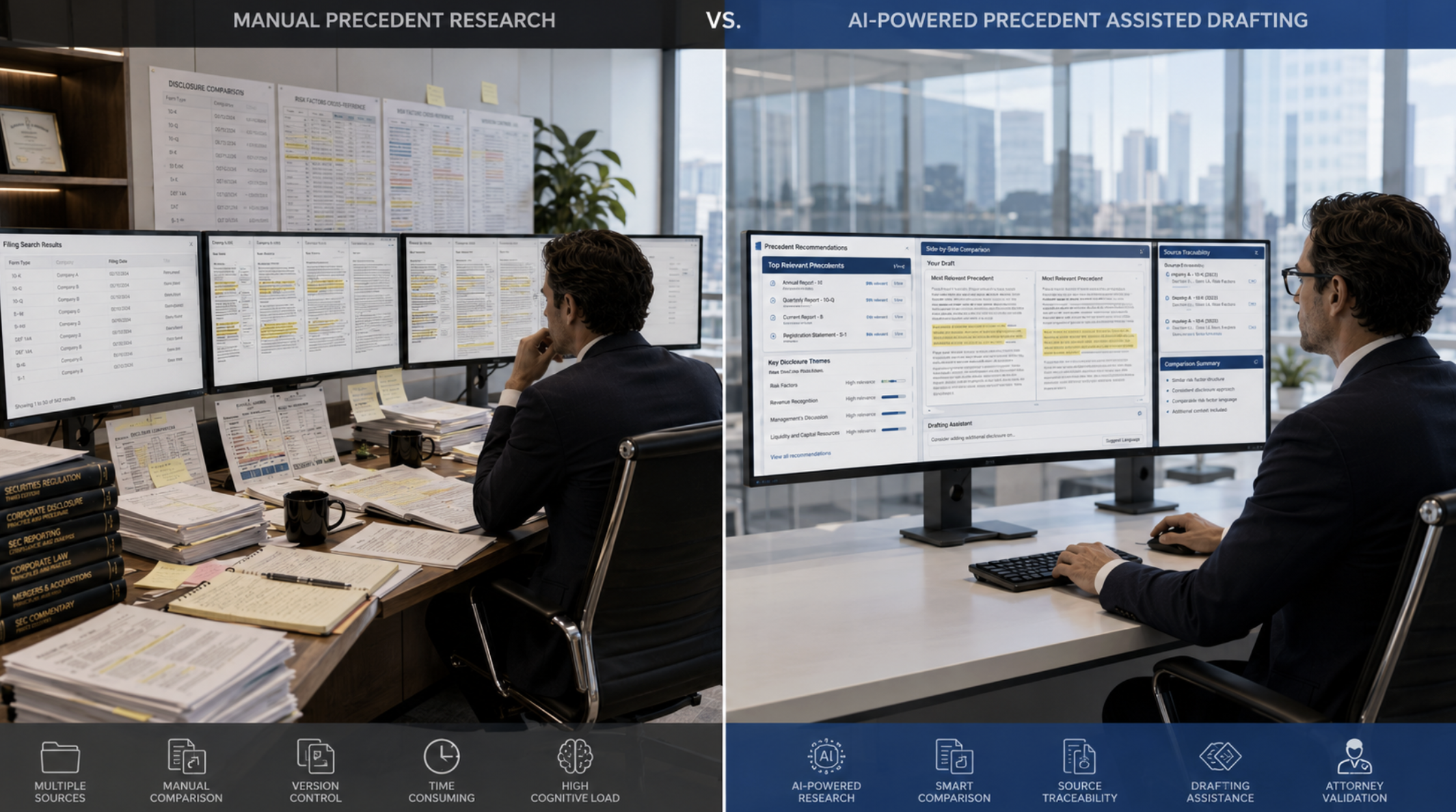
AI SEC filing software is changing how public company legal teams evaluate SEC drafting workflows. Yet many organizations still prepare disclosures through a manual process that relies on EDGAR searches, copy-pasting precedent language, and legal judgment. Attorneys and securities professionals identify comparable filings, adapt disclosures to the current transaction or reporting period, and determine whether the final document meets SEC reporting requirements.
This approach remains common because precedent is central to SEC drafting. Reviewing prior Form 10-K, Form 8-K, Form S-1, and other SEC filings helps legal teams maintain consistency and align disclosures with established reporting practices. However, manual precedent research also requires significant time to locate comparable filings, compare disclosure language, manage document versions, and coordinate reviews across multiple contributors.
As organizations evaluate AI SEC filing software, it is important to distinguish between filing platforms, document management tools, and precedent-based AI. Some solutions support filing logistics, while others improve drafting by organizing structured precedent data from public SEC filings.
This SEC filing software comparison explores AI vs. manual SEC drafting, explains how automated SEC filing software differs from traditional precedent research, and highlights where a precedent-based workflow can improve drafting efficiency, auditability, and traceability.
The Manual Process: Where Time Is Lost and Risk Begins
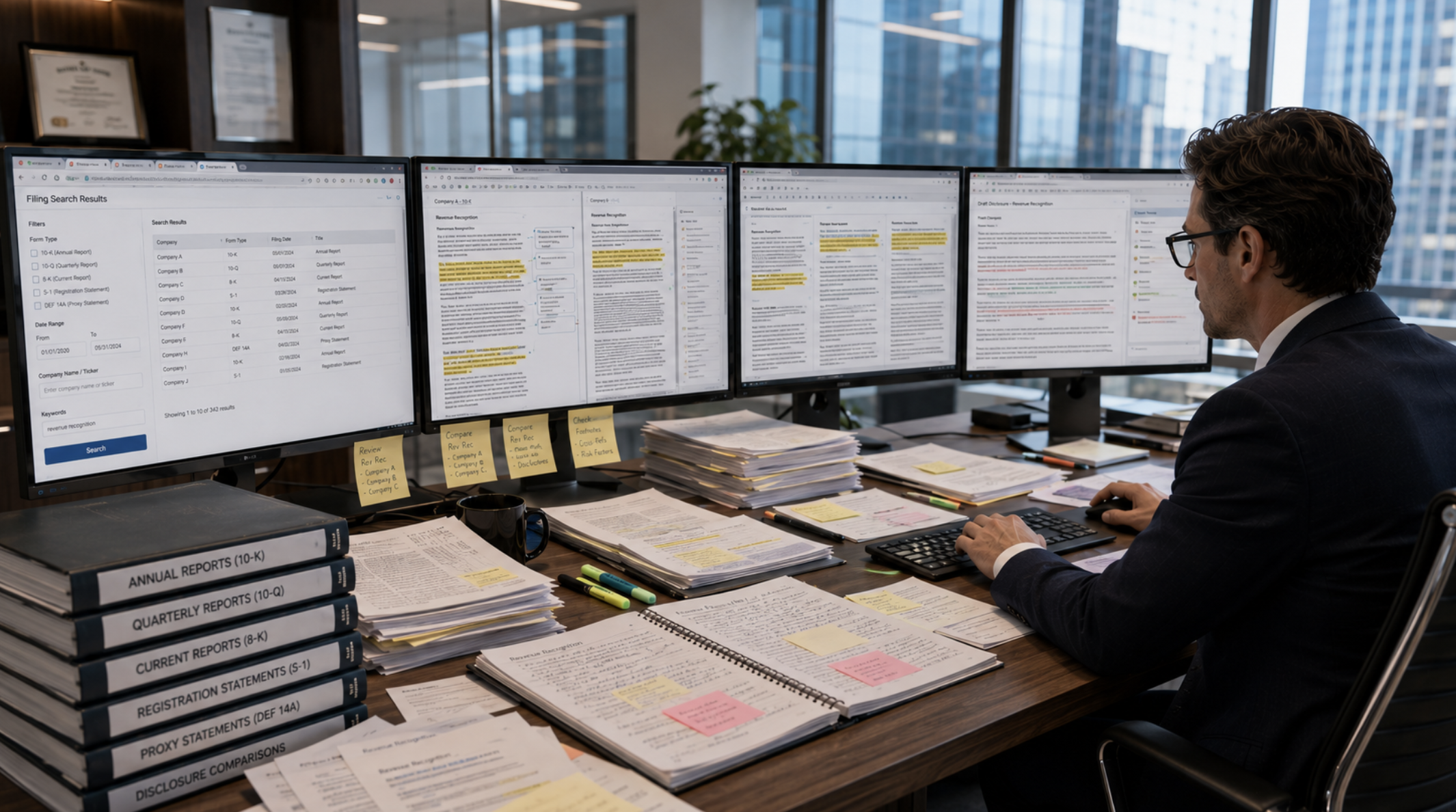
Most public company legal teams begin drafting with precedent research rather than a blank document. Attorneys search EDGAR for comparable SEC filings, review disclosure language from prior Form 10-K, Form 8-K, or Form S-1 filings, adapt relevant language to the current transaction or reporting period, and validate each revision before submission. For a closer look at this research process, see our guide to researching SEC precedent filings with EDGAR.
This manual approach supports consistent SEC reporting, but several stages require significant time and coordination.
- Researching comparable filings. Attorneys identify companies with similar reporting requirements, industries, or transaction structures, then review multiple filings to determine the most relevant precedent.
- Comparing disclosure language. Legal teams evaluate multiple precedents to understand differences in disclosure structure, terminology, and company-specific reporting before drafting.
- Managing document versions. Drafts move between legal, finance, investor relations, and outside counsel, requiring teams to reconcile edits across multiple review cycles.
- Reviewing disclosures. Before filing, legal teams verify factual accuracy, disclosure consistency, and alignment with SEC reporting requirements.
Because much of this work is performed manually, administrative tasks can create opportunities for errors, including:
- Referencing an outdated precedent
- Missing a more relevant comparable filing
- Introducing inconsistent disclosure language
- Overlooking edits during document reconciliation
- Spending additional time validating copied disclosure language
Precedent research remains a critical part of SEC drafting. The challenge is not whether to use precedent, but how to manage the research, drafting, and review process more efficiently as filing complexity increases.
What AI SEC Filing Software Actually Does
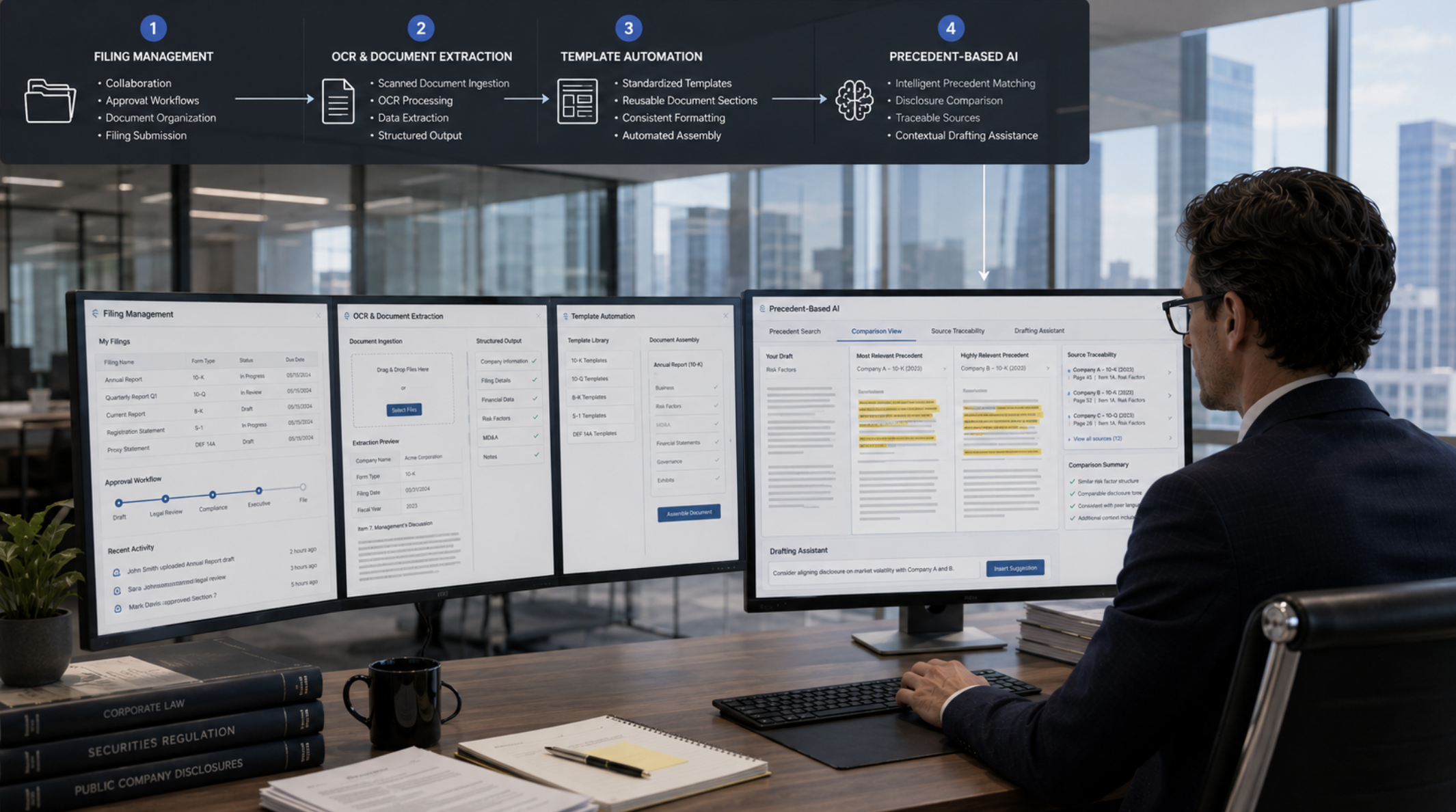
Not all AI SEC filing software supports the same part of the SEC reporting process. Some platforms manage filing preparation and EDGAR submission, while others automate document extraction or template-based tasks. Understanding these differences is essential when evaluating SEC drafting solutions.
Filing Platforms
Traditional filing platforms help legal and finance teams prepare, collaborate on, validate, and submit SEC filings through EDGAR. These platforms streamline document management and filing workflows, but they are not designed to identify relevant precedent or determine how disclosures should be drafted.
OCR and Template-Based Automation
OCR and template-based tools automate document extraction, data entry, and recurring document formats. While these capabilities reduce administrative work, legal teams must still research comparable SEC filings, evaluate precedent, and determine whether disclosure language reflects the current transaction, reporting period, or regulatory requirements.
Precedent-Based AI for SEC Drafting
Precedent-based AI supports a different stage of the workflow. Rather than generating disclosures without context, it uses structured data from public SEC filings to benchmark, draft, revise, and review disclosures based on relevant precedent.
Dimension AI is built around this precedent-based approach. Its workflows extract and structure data from public SEC filings, producing outputs that remain traceable to the original source. Legal teams can review supporting precedent, compare changes, and verify disclosures while maintaining attorney oversight throughout the drafting process.
For organizations evaluating automated SEC filing software, the key distinction is how the technology supports drafting. Precedent-based workflows provide auditable, source-backed outputs that help legal teams research, draft, and review SEC disclosures more efficiently while preserving professional judgment.
If you're comparing available solutions, explore our Best SEC Filing Software for AI-Assisted Drafting and Review for a broader look at today's SEC drafting and filing platforms.
Manual Research vs. AI SEC Filing Software: A Side-by-Side Comparison
Choosing AI SEC filing software involves more than comparing drafting speed. Legal teams should evaluate how each approach supports precedent research, drafting consistency, auditability, version control, and attorney review throughout the SEC reporting process.
| Factor | Manual Precedent Research | AI (Dimension AI) |
|---|---|---|
| Time per filing section | Multiple EDGAR searches, reviewing comparable filings, copying disclosure language, and manual revisions. | Precedent-based workflows benchmark, draft, revise, and review SEC disclosures using structured data from public SEC filings. |
| Precedent coverage | Depends on attorney experience, institutional knowledge, and available research time. | Structured precedent data with traceable source material from public SEC filings. |
| Consistency | Can vary across contributors and review cycles. | Supports consistent drafting through precedent-based workflows. |
| Audit trail | Documented through reviewer comments, document history, or internal notes. | Auditable outputs with traceable source references. |
| Version control | Multiple working drafts require manual reconciliation across review cycles. | Structured review workflows simplify change tracking while maintaining traceability. |
This SEC filing software comparison highlights an important distinction. Precedent-based AI supports legal professionals by organizing precedent research and drafting workflows, not by replacing attorney judgment. Legal teams remain responsible for reviewing, editing, and approving every SEC disclosure before filing.
Filing platforms, document management systems, and precedent-based drafting tools address different stages of the SEC reporting process. Understanding those differences helps organizations evaluate which solution best supports their drafting workflow.
"We Already Use Workiva or DFIN." Isn't That Enough?
Legal and compliance teams evaluating AI SEC filing software often ask whether an additional solution is necessary if they already use platforms such as Workiva or Donnelley Financial Solutions (DFIN).
The answer depends on which part of the SEC reporting workflow they want to improve.
Workiva and DFIN support critical reporting functions, including document collaboration, workflow management, validation, and SEC filing preparation. These capabilities help organizations manage complex reporting processes, but legal teams still perform much of the precedent research and disclosure drafting before a filing is ready for review and submission.
Filing Platforms and Precedent-Based Drafting Support Different Workflows
Filing platforms help organizations answer operational questions, such as:
- How is the filing assembled?
- Who reviews each section?
- Which draft is the current version?
- When is the filing submitted through EDGAR?
Precedent-based drafting addresses a different set of questions, including:
- Which public SEC filings provide the most relevant precedent?
- How have comparable companies disclosed similar transactions or risk factors?
- Can every disclosure be traced to its supporting source material?
- How can drafting remain consistent across multiple reporting periods?
These capabilities are complementary rather than competing. Organizations adopting precedent-based drafting workflows are not replacing their filing platform. They are improving the research, drafting, and review process that takes place before the filing moves through existing collaboration, approval, and EDGAR submission workflows.
Signs Manual Precedent Research Is Becoming a Business Risk
Manual precedent research remains a core part of SEC drafting. However, as filing volume, transaction complexity, and reporting obligations increase, manual workflows can become more difficult to scale. If legal teams spend more time locating precedent than evaluating disclosures, it may be time to reassess the drafting workflow.
Common indicators include:
- Precedent research delays drafting. Attorneys spend significant time searching EDGAR, reviewing multiple public SEC filings, and comparing disclosure language before drafting can begin. If your team relies heavily on manual EDGAR research, our guide on How Legal Teams Use EDGAR to Research Precedent SEC Filings explains how to structure precedent searches more effectively.
- Review cycles continue to expand. Legal teams spend additional time validating precedent, confirming source documents, or reconciling inconsistent disclosure language instead of focusing on legal analysis.
- Version control becomes harder to manage. Multiple contributors, tracked changes, and parallel drafts make it more difficult to identify the latest approved language and maintain consistency throughout the filing.
- Drafting varies across similar filings. When precedent selection depends primarily on individual experience, similar disclosures in Form 10-Ks, Form 10-Qs, or Form S-1 registration statements may be drafted differently across reporting periods.
- Source traceability requires manual verification. Reconstructing which public filing supports a specific disclosure can slow internal review and make audit preparation more time-consuming.
- Reporting demands outpace available resources. Additional SEC filings, capital markets transactions, or periodic reporting obligations increase precedent research without a corresponding increase in legal capacity.
These indicators do not suggest that manual SEC drafting is ineffective. They indicate that repetitive research and document management may be limiting efficiency. A precedent-based workflow helps legal teams organize research, maintain traceability to supporting SEC filings, and spend more time applying legal judgment during drafting and review.
Choosing the Right Approach for Modern SEC Drafting
Evaluating AI SEC filing software is not about replacing attorney judgment. It is about improving how legal teams research precedent, draft disclosures, and review SEC filings while maintaining accuracy, traceability, and auditability.
Manual precedent research remains a fundamental part of SEC drafting. The difference lies in how precedent is identified, organized, and applied. Traditional workflows rely on manual EDGAR research, document comparison, and version tracking. Precedent-based workflows help legal teams benchmark, draft, revise, and review disclosures using structured data from public SEC filings while preserving attorney oversight.
When comparing solutions, consider whether the software:
- Supports drafting with relevant SEC precedent.
- Provides traceable source references for every recommendation.
- Produces auditable outputs that simplify review.
- Preserves attorney oversight throughout the drafting process.
- Integrates with existing SEC reporting and filing workflows.
These criteria provide a more meaningful basis for evaluation than feature comparisons alone.
Ready to see how precedent-based drafting works in practice? Book a demo of the Dimension AI Platform to see how legal teams benchmark, draft, revise, and review SEC filings using traceable precedent data from public SEC filings.
To access this endpoint, you must have an approved developer account, and have activated the new developer portal. When authenticating, you must use keys and tokens from a developer App that is located within a Project. Learn more about getting access to the API v2 endpoints in our "Getting started" page:
Once you have the API v2 collection loaded in Postman
The hide replies endpoint uses OAuth 1.0a user context authentication. If successful, the endpoint hides a single Reply that was published in a Tweet conversation that was initiated by an authenticated user. Each conversation supports hiding up to 725
This endpoint gives you the ability to programmatically hide or unhide replies using criteria you define. Just like the functionality in the main
There are several different tools and libraries that you can use to make a request to this endpoint, but we are going to use the Postman tool here to simplify the process.